
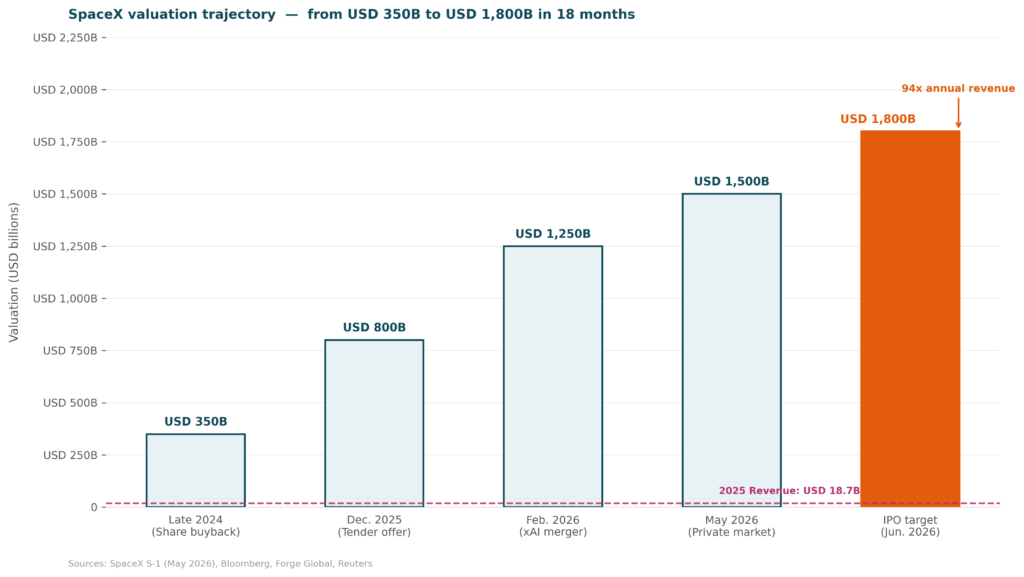
On May 20, 2026, SpaceX filed its official stock market listing prospectus with the US securities regulator, targeting a debut under the ticker SPCX on the Nasdaq on June 12. The target valuation: USD 1.8 trillion. That would make it the largest stock market listing in history, surpassing Saudi Aramco (USD 25.6 billion raised in December 2019). SpaceX is looking to raise USD 75 billion in a single operation.
The problem flagged by many analysts: in 2025, SpaceX generated USD 18.7 billion in revenue and lost USD 4.94 billion. The target valuation represents 94 times its annual revenue. By comparison, Apple trades at around 10 times its own. Microsoft at around 9 times.
Why this matters
The method investment banks are using to justify this valuation is called the total addressable market. The argument: if SpaceX eventually captures a meaningful share of a potential market worth USD 28 trillion (roughly the size of the entire US economy), then the current valuation is justified. That is a projection of an imaginary future sold as a financial argument.
This kind of reasoning is well established in venture capital: rather than measuring what a company is worth today, you price what it could be worth if every optimistic scenario played out at once. The difference here is that SpaceX is not a garage startup — it is a USD 18 billion revenue business. That shift from speculative growth logic to a public market listing is precisely what has drawn the sharpest scrutiny from financial analysts worldwide.
The prospectus reveals three fundamentally different businesses bundled under a single number. Starlink, the satellite internet network: USD 11.4 billion in revenue, profitable. The rocket launch business: USD 4.1 billion. And the artificial intelligence division, created through the merger with xAI: USD 3.2 billion in revenue, but USD 6.4 billion in operating losses. The activities generating real profit today represent, according to analysts, no more than 7% of the valuation being offered to public investors.
SpaceX’s earliest shareholders invested when the company was valued at just a few billion dollars. Its most recent private investors, in December 2025, paid on the basis of a USD 800 billion valuation. A public listing at USD 1.8 trillion translates into a very different exit multiple for each of them. The price being asked of public market buyers reflects all of those premiums.
What most people miss: a valuation is not an objective measurement. It is a constructed financial argument designed to make a transaction happen. Investment banks are not searching for the “true value” of SpaceX — they are building the most compelling narrative they can to get the deal done. Understanding how that narrative is built is understanding how the price of any company gets set.
To understand how investment banks build a valuation,
read the Fundamental “Business Valuation: Methods, Practices, and the Startup Edge Case.”
─────────────────────────────────────────────
Article by The Foundations – The fundamentals behind the headlines

SpaceX is going public at USD 1.8 trillion. Its revenue: USD 18.7 billion.

Meta acquired Manus. China ordered it to unwind the deal.

Mergers & Acquisitions (M&A)

The US is paying more in interest on its debt than it spends on defense. Moody’s has delivered its verdict.

Public Debt