

China just added three years to your working life. So will everyone else.
The fact
On January 1, 2025, China did what it had been putting off for 70 years: it raised the retirement age. Men will move gradually from 60 to 63, women in managerial roles from 55 to 58, and blue-collar women from 50 to 55. The transition runs over 15 years. Behind the move: 297 million Chinese citizens are now over 60, making up 21% of the population. Without reform, the national pension fund was projected to run dry before 2035.
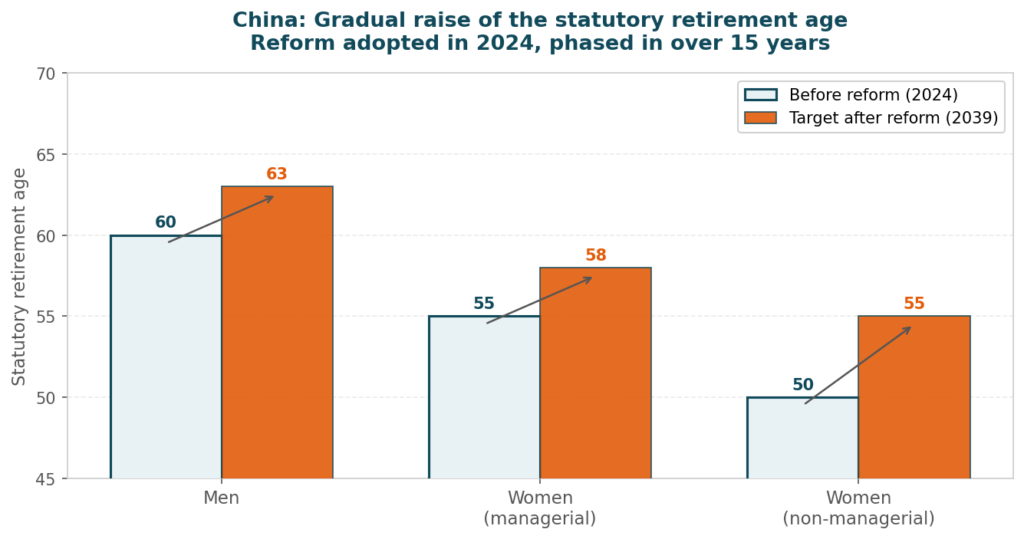
Source: Standing Committee of the National People’s Congress of China, Sept. 2024
Why it matters
Pay-as-you-go pension systems rest on a single number: the ratio of workers to retirees. In 1960, there were 7.2 workers for every retiree worldwide. Today: 4.0. By 2050, UN projections put that figure at 2.8 globally, and below 2.0 in the most advanced economies. When that ratio collapses, governments have exactly three levers to pull: retirement age, benefit levels, contribution rates. There are no others. China just pulled the first.
China is an extreme case. Four decades of the one-child policy have pushed the fertility rate to roughly 1.0, well below the 2.1 replacement threshold. No country of comparable size is ageing this fast.
The question was never whether these adjustments would happen. It was always who would absorb them, and when.
The reform is unpopular. Online, the sharpest criticism isn’t about the numbers themselves but about a contradiction that is hard to ignore: major Chinese employers routinely push workers out at 35. Being asked to stay in the workforce until 63 looks less like a delayed retirement and more like a promise the labor market has no intention of keeping. That tension is not unique to China. Japan and parts of southern Europe are navigating the same gap between the legal retirement age and the real employability of older workers.
From 2030, China will also raise the minimum contribution period required for a full pension, from 15 to 20 years by 2040. Age and contribution years adjusted in tandem, to close the same structural gap.
Go deeper
What is happening in China comes down to a tension between two opposing funding logics, pay-as-you-go and funded systems, and the choices every ageing country is forced to make between them. That is the subject of the Fundamental: Retirement Systems: Demographics, Funding, and Reform. The three levers of any reform, the two funding models, and the real-world responses adopted in Sweden, Australia, Chile, Japan and beyond, so you can read the next government announcement yourself.
─────────────────────────────────────────────
Article written by The Foundations – The basics to understand current events

SpaceX is going public at USD 1.8 trillion. Its revenue: USD 18.7 billion.

Meta acquired Manus. China ordered it to unwind the deal.

Mergers & Acquisitions (M&A)

The US is paying more in interest on its debt than it spends on defense. Moody’s has delivered its verdict.

Public Debt