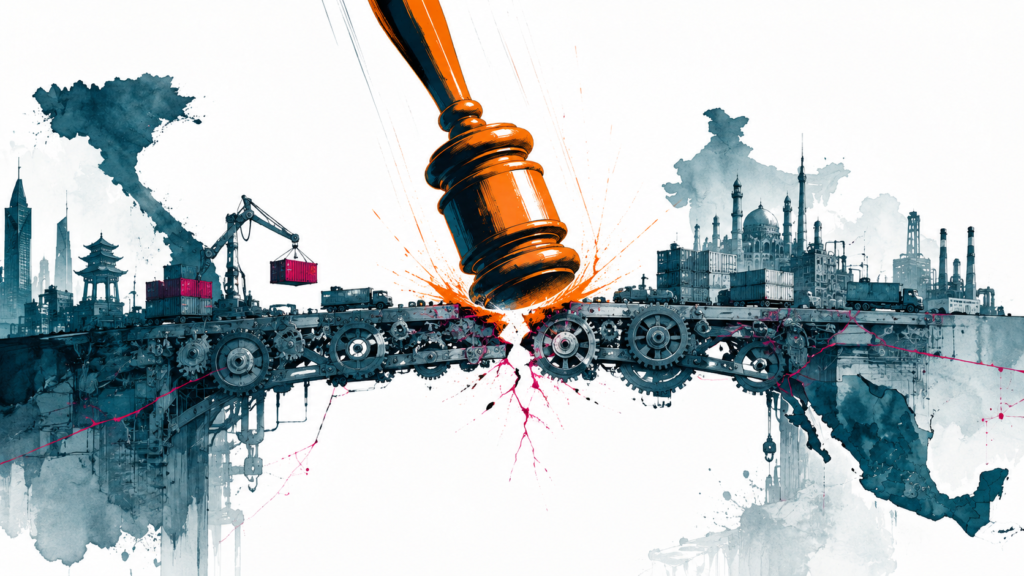
Twice in 78 days, courts told Washington no. Global trade is still waiting to find out what it owes.
In February 2026, the US Supreme Court struck down the sweeping import duties the Trump administration had imposed on goods from nearly every country, using an emergency economic powers law. Within hours, the administration turned to a different statute: a provision allowing the president to impose a temporary 10% surcharge on imports to address what he deemed an excessive trade deficit. On May 7, a federal trade court invalidated those duties as well, ruling that the legal conditions for invoking the law had not been met. An appeals court has since put that ruling on hold, and the tariffs continue to be collected. Two tariff programs struck down in 78 days. Businesses importing goods into the United States still have no reliable answer to a basic question: what do I actually owe today?
Why this matters
What most people don’t realize is that a customs duty has not been a simple border tax for decades. It is the start signal, or the stop signal, for entire production sequences spread across continents.
A factory in Vietnam assembles components designed in South Korea and manufactured in China, for customers in the United States. That model, the global value chain, was engineered to squeeze efficiency out of every link. The tradeoff: even a brief spell of tariff uncertainty ripples through every link at once.
The numbers are striking. Nearly $166 billion in duties now ruled illegal are being refunded. The Federal Reserve Bank of New York found that 90% of tariff costs were absorbed by American businesses and consumers, the reverse of the intended effect. The Tax Foundation puts the additional household burden at roughly $1,300 in 2026.
The disorder may ultimately cost more than the tariffs themselves. Companies cannot place orders, lock in contracts, or plan inventory when the rules can change on a court filing. Factories in Hanoi, Mumbai, and Monterrey that supply US markets are pricing this uncertainty into every investment decision they make.
Understanding why a ruling in an American courtroom can bring an Asian factory floor to a halt means understanding how global value chains were built in the first place. And what that architecture actually demands of the world.
To understand how global value chains were built, why they amplify every tariff shock, and what actually happens when a government tries to bring production back home, read the Fundamental “International Trade and Value Chains.”
Read the Fundamental →─────────────────────────────────────────────
Article written by The Foundations – The basics to understand current events
www.thefoundations.co
SpaceX is going public at USD 1.8 trillion. Its revenue: USD 18.7 billion.
Meta acquired Manus. China ordered it to unwind the deal.
Mergers & Acquisitions (M&A)
The US is paying more in interest on its debt than it spends on defense. Moody’s has delivered its verdict.
Public Debt