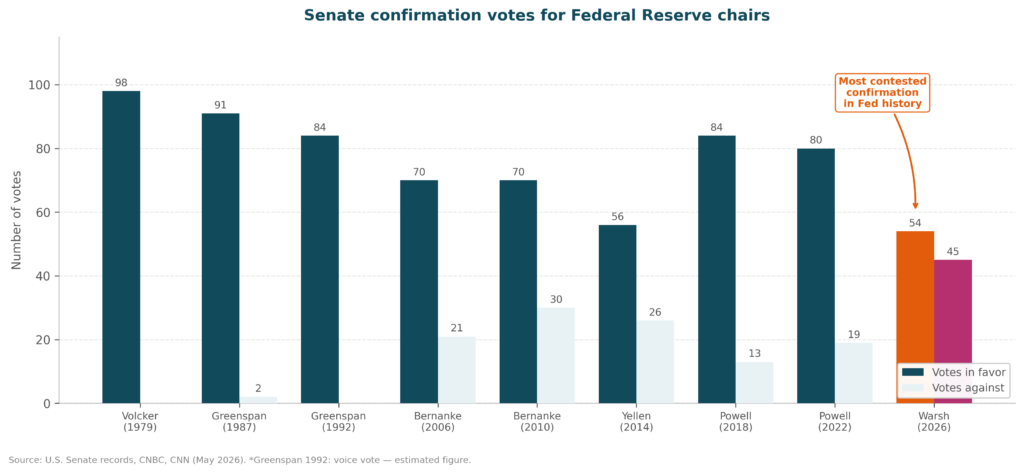
On May 13, 2026, the U.S. Senate confirmed Kevin Warsh as the 17th chair of the Federal Reserve. The vote: 54 in favor, 45 against. A single Democratic senator crossed the aisle.
It was the most contested confirmation in the institution’s history. For context: Jerome Powell was confirmed 84–13 in 2018. Janet Yellen 56–26 in 2014. Ben Bernanke 70–30 in 2010 — a record at the time.
Warsh, 56, previously served on the Fed’s Board of Governors from 2006 to 2011. He takes the helm at a difficult moment: the U.S. Producer Price Index jumped 6.0% year-on-year in April, its fastest pace since 2022. His first FOMC meeting as chair is scheduled for June 16–17.
Why this matters
A partisan vote on a Fed chair has never happened before. And that’s not a procedural footnote.
Since its founding in 1913, the Federal Reserve has operated on a single foundational premise: it sets interest rates based on economic data, not on whoever happens to be in the White House. The bipartisan confirmation vote was the visible signal of that consensus — senators from both parties agreeing that this appointment was about competence, not politics. A 54–45 vote says exactly the opposite.
Why does central bank independence matter so much? Because monetary policy works primarily through expectations. If businesses and households believe that rates will be held high enough, long enough to contain inflation, they adjust their behavior accordingly — they don’t pre-emptively raise prices or demand outsized wage increases. That belief is what stops an inflation spiral before it starts. The moment it wavers, everything gets harder.
Here is the sequence that produced this historic vote.
For months, Donald Trump had been pressuring Jerome Powell to cut rates, calling Fed policy too restrictive. Powell held firm, citing inflation data that still ran above target.
In January 2026, the Department of Justice opened a criminal investigation into Powell — officially tied to cost overruns on a renovation of the Fed’s Washington headquarters. Powell publicly called it a political operation. A federal judge blocked the subpoenas. But the signal had been sent.
That’s when a Republican senator, Thom Tillis of North Carolina, announced he would refuse to vote for any Trump Fed nominee until the investigation was dropped. His position was simple: using a criminal probe to pressure a central bank chair crossed an institutional line that should not be crossed, regardless of party.
The investigation was eventually dropped. Tillis lifted his hold. Warsh was confirmed. But the federal prosecutor who led the case noted she could reopen it if the Fed’s inspector general found evidence of wrongdoing.
What the PPI figure actually means. The Producer Price Index measures what manufacturers and suppliers pay upstream in the supply chain — raw materials, energy, freight, industrial components. When it rises sharply, businesses pass those costs on to consumers, typically with a two-to-three month lag. A PPI of +6.0% in April 2026 is therefore a leading signal: it points to renewed inflationary pressure heading into the summer.
The last time U.S. producer prices rose this fast was 2022, when the post-Covid energy shock drove consumer inflation to 9%. Against that backdrop, markets are no longer pricing in any rate cuts for 2026. Some are now pricing in a hike.
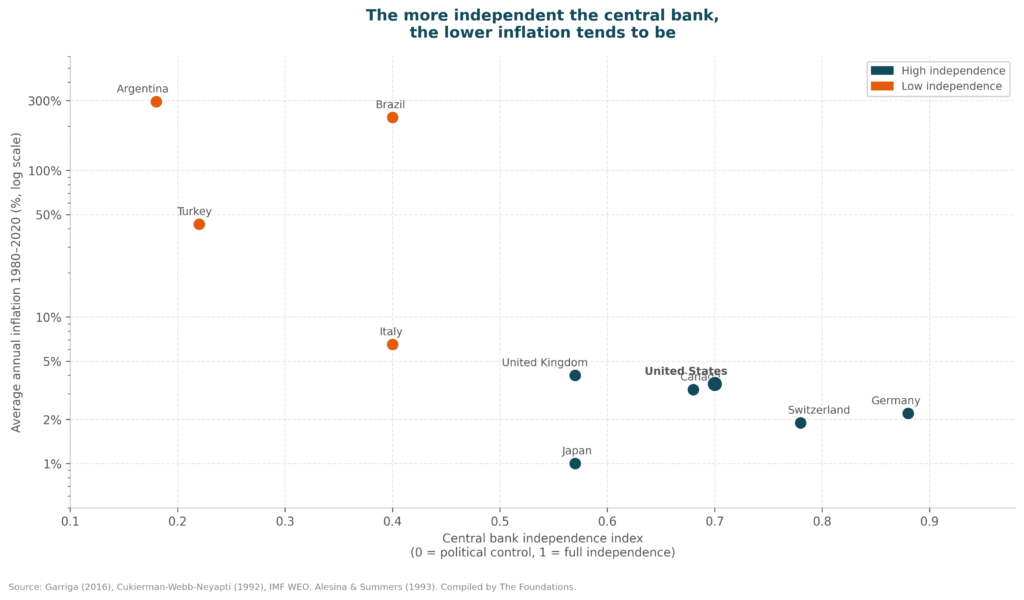
The irony at the end of this story. Warsh cannot cut rates on White House orders, even if he wanted to. The federal funds rate is decided by the FOMC — a twelve-member committee made up of Fed governors and regional reserve bank presidents. Warsh controls the agenda. He does not control the majority.
Several committee members have recently signaled publicly that a rate hike is not off the table. Trump may have secured the title. The institutional mechanism he wanted to bypass is still very much in place.
To understand how a central bank actually sets rates, why its independence anchors price stability, and what unravels when that independence is challenged, read the Fundamental “Interest Rates and Monetary Policy.”
Read the Fundamental →─────────────────────────────────────────────
Article written by The Foundations – The basics to understand current events
www.thefoundations.co

SpaceX is going public at USD 1.8 trillion. Its revenue: USD 18.7 billion.
Meta acquired Manus. China ordered it to unwind the deal.

Mergers & Acquisitions (M&A)
The US is paying more in interest on its debt than it spends on defense. Moody’s has delivered its verdict.
Public Debt