

The fact
On April 15, Donald Trump publicly threatened to fire Federal Reserve Chair Jerome Powell if he doesn’t vacate his post when his term expires on May 15. The Supreme Court is simultaneously weighing a related case — whether the president can remove Fed Governor Lisa Cook from the Board. At stake is a principle that rarely gets named out loud: central bank independence.
Why it matters
Central bank independence isn’t a procedural technicality. It’s the mechanism that determines, in practice, how much your prices rise each year. When a government can lean on its central bank to cut rates and stimulate growth — or to quietly monetize the national debt — inflation tends to untether. Sometimes gradually. Sometimes not.
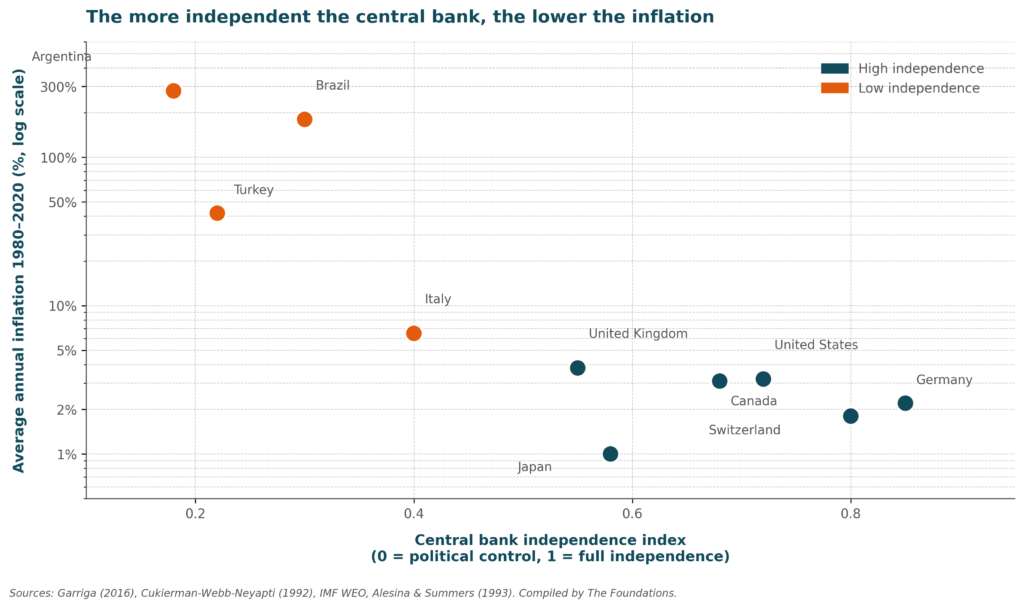
The historical record is unambiguous. Over four decades, countries that kept politics out of their monetary policy — Germany, Switzerland, Canada — averaged around 2% annual inflation. Those where the executive held sway — Argentina, Turkey, Brazil — ran decades at 40%, 180%, even higher. This isn’t a statistical anomaly. It’s the same mechanism playing out across dozens of countries, over and over again.
What’s unfolding in Washington isn’t simply a clash between a president and a technocrat. It’s a stress test on the credibility of the world’s reserve currency. And credibility, once cracked, takes years — sometimes generations — to rebuild.
Go deeper
To understand how a central bank actually sets rates, why its independence anchors price stability, and what unravels when that independence disappears, read the Fundamental “Interest Rates and Monetary Policy.”
Read the Fundamental →─────────────────────────────────────────────
Article written by The Foundations – The basics to understand current events
www.thefoundations.co

SpaceX is going public at USD 1.8 trillion. Its revenue: USD 18.7 billion.

Meta acquired Manus. China ordered it to unwind the deal.

Mergers & Acquisitions (M&A)

The US is paying more in interest on its debt than it spends on defense. Moody’s has delivered its verdict.

Public Debt