
Alphabet raised $80 billion in a single move. What the number says about who still gets to compete in AI.
The fact
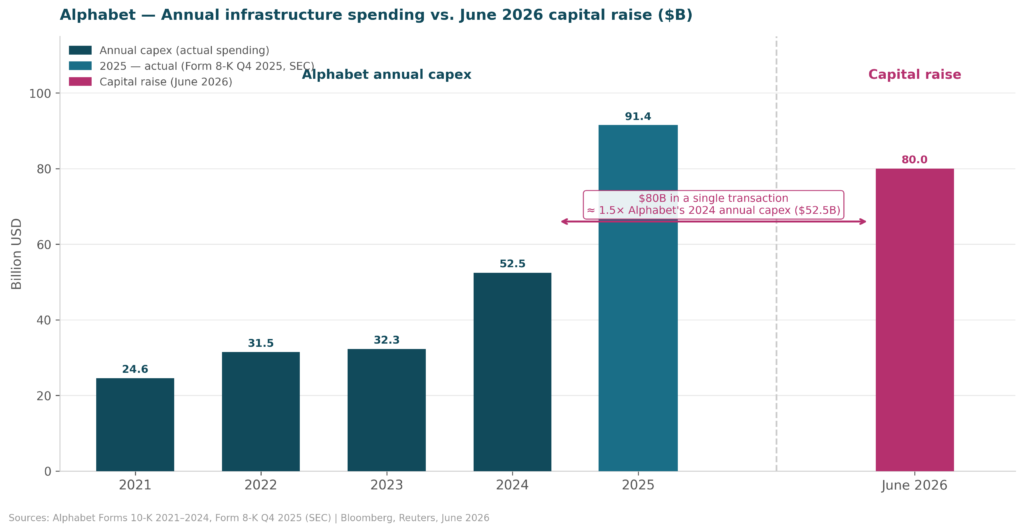
This week, Alphabet announced an $80 billion share offering to fund its AI infrastructure. Berkshire Hathaway is taking a $10 billion stake. Markets weren’t thrilled: the stock dropped as much as 3.5% intraday, though it largely recovered by the close.
Why it matters
In 2024, the four largest tech companies worldwide — Microsoft, Google (Alphabet), Amazon, and Meta — together spent more than $200 billion on infrastructure. Alphabet has just added $80 billion to that total in a single transaction.
What most people miss: this isn’t a standard capital raise. It’s an industrial commitment. Training a single top-tier AI model now costs anywhere from $50 million to $500 million. Running the data centers behind it takes tens of thousands of specialized chips, a dedicated power supply, and engineering teams spread across the globe.
The direct result: fewer than ten labs worldwide can realistically build the most powerful models. That’s not a market outcome — it’s a structural barrier, and every billion spent makes it harder to cross.
What Alphabet is funding isn’t a product. It’s industrial infrastructure — the kind built to last decades. The 19th century had railways. The 20th had power grids. Whoever laid the tracks controlled where things went. The same logic applies here.
To understand how massive AI investments are creating unprecedented industrial concentration, read the Fundamental “Artificial Intelligence: How It Works and Why It Matters.”
Read the Fundamental →Sources and references
─────────────────────────────────────────────
Article by The Foundations – The fundamentals behind the headlines
India’s Demographic Shift

Demographic Transition: Aging, Fertility and Consequences
Alphabet raises $80 billion to fund AI

International Migration: Flows, Causes and Impact
China makes 80% of the world’s solar panels. And is losing billions.