
India has entered the ageing phase. It wasn’t supposed to happen this soon.
The fact
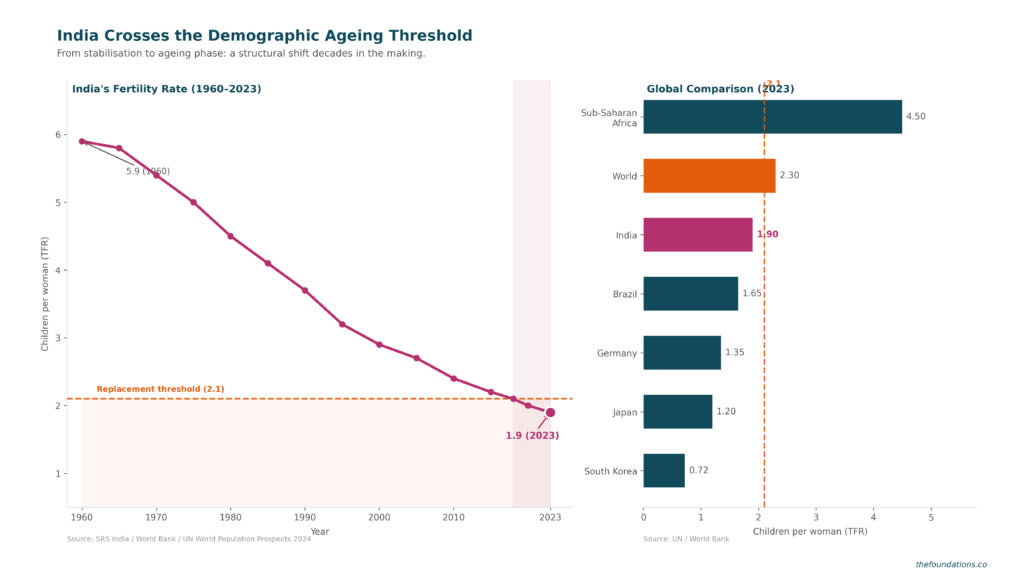
In 2023, India’s fertility rate dropped to 1.9 children per woman, according to official data from the Indian Civil Registration System (SRS). This marks the first time the figure has fallen below the replacement threshold of 2.1. Some states, including Tamil Nadu and West Bengal, now record rates comparable to Finland’s. India joins the two-thirds of countries worldwide already below this threshold, including emerging economies such as Brazil, Iran, and Turkey.
Why it matters
Demographic transition unfolds in four phases. India was expected to remain in the stabilisation phase for decades: young, growing, with a demographic dividend projected to last through the 2040s. Falling below 2.1 signals that it is entering the ageing phase earlier than anticipated.
The consequences are not immediate. They build over decades, but they are mechanical. An ageing population consumes less, takes fewer risks, and innovates less. Japan provides the clearest illustration: despite three decades of expansionary economic policy, its annual GDP growth has averaged under 1%. South Korea spent the equivalent of $200 billion on pro-natalist policies between 2006 and 2023. Its fertility rate kept falling throughout that period.
India faces a particular challenge: it is entering this phase without the social safety net that Western countries had built before ageing. No universal pension system. A GDP per capita that remains very low. It is crossing this threshold before it has the resources to absorb the transition. That gap, between the pace of demographic ageing and the capacity to finance it, is the most underestimated structural challenge of the coming decades.
To understand how global demographic transition is reshaping economic balances and putting pressure on social systems, read the Fundamental “Demographic Transition: Aging, Fertility and Consequences.”
Read the Fundamental →Sources and references
─────────────────────────────────────────────
Article by The Foundations – The fundamentals behind the headlines
India’s Demographic Shift

Demographic Transition: Aging, Fertility and Consequences

Alphabet raises $80 billion to fund AI

International Migration: Flows, Causes and Impact
China makes 80% of the world’s solar panels. And is losing billions.