Fox-Roku: the 2% antitrust filter that decides big deals
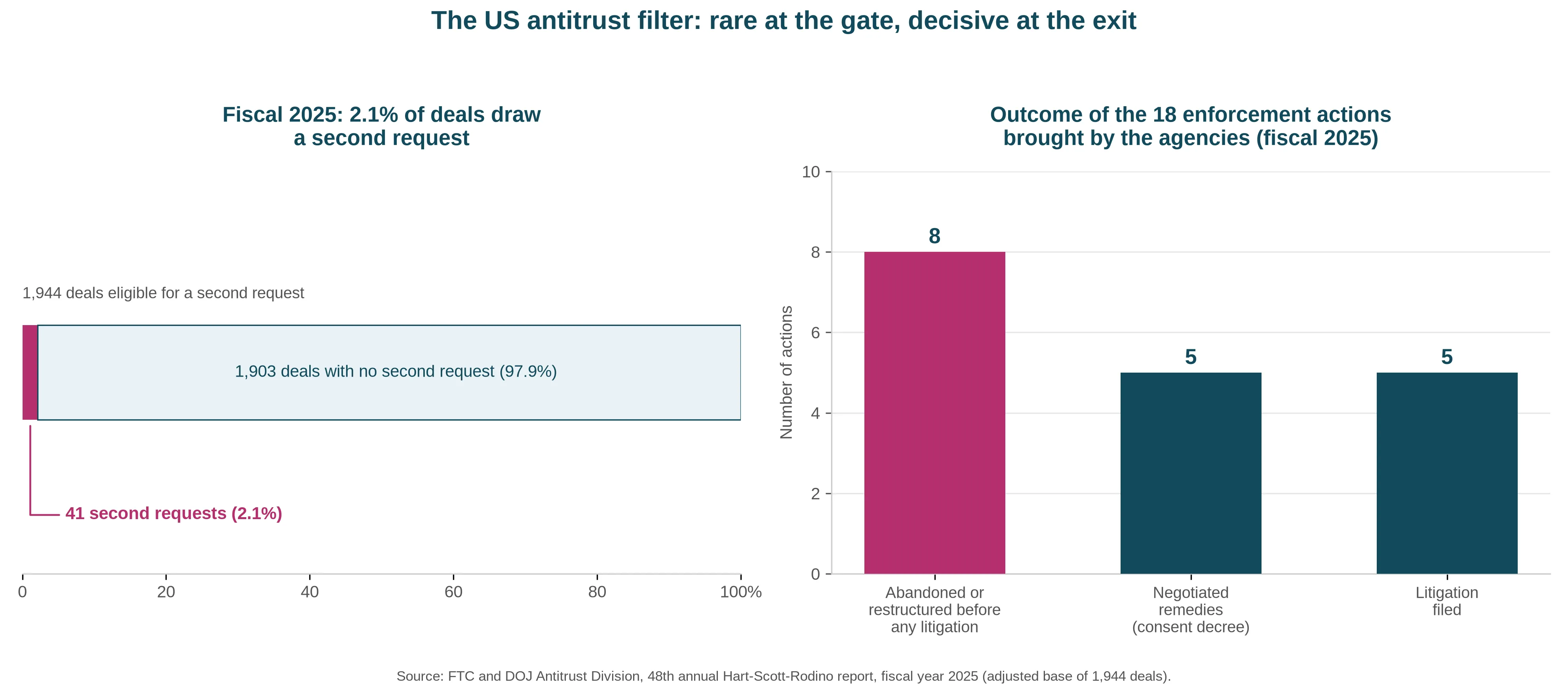
A request for documents blocks nothing. It hits only 2.1% of notified deals, yet what it triggers usually ends in abandonment or restructuring rather than in front of a judge. Merger control works through the calendar far more than through any verdict.

The fact
On 8 September 2026, the US Department of Justice sent Fox and Roku a “second request” for documents in its review of their $22 billion combination. Nothing has been blocked: the agencies are simply asking for more paperwork. Fox still targets a close in the first half of 2027.
Why it matters
A request for documents sounds procedural. Statistically, it is the moment a deal’s odds flip. In fiscal year 2025, 2,006 transactions were notified to the US agencies; 1,944 of them were eligible for a second request, and 41 drew one: 2.1%. The filter is narrow, and what passes behind it changes shape. That same year the agencies brought 18 enforcement actions: 8 ended with the deal abandoned or restructured before any litigation, 5 with negotiated remedies, and only 5 with a case filed in court.
The mechanism is about the calendar, not the verdict. Until the parties have “substantially complied”, the regulatory clock stays stopped, and thirty more days run after that. Complying means months of document collection. The same logic runs elsewhere under other names: a European Phase II opens 90 working days of in-depth investigation, a British Phase 2 runs 24 weeks, and both can be extended. Regulators rarely block. They make things last.
The stakes are concrete. For the target’s shareholders, the announced price stops being the expected price: the gap with the share price now measures a probability rather than a premium. For employees on both sides, uncertainty settles in for a year or more. For rivals, every month gained is a month the buyer cannot integrate anything. A deal can die without a single judge ruling on it, simply because it ended up costing too much time.
To understand the full mechanics of a deal, from first contact to integration, read the Fundamental: “Mergers and acquisitions: how M&A deals work.”
You'll learn why due diligence cuts the price on 30 to 40% of deals, how the acquisition premium is calculated, and why promised synergies so rarely materialise.
Read the Fundamental →