AI chip boom: TSMC reveals the scale of the capex surge
The company that makes almost every advanced AI chip just posted a 67.9% jump in June sales. Behind that number sits a cycle mechanism few readers can name.

The fact
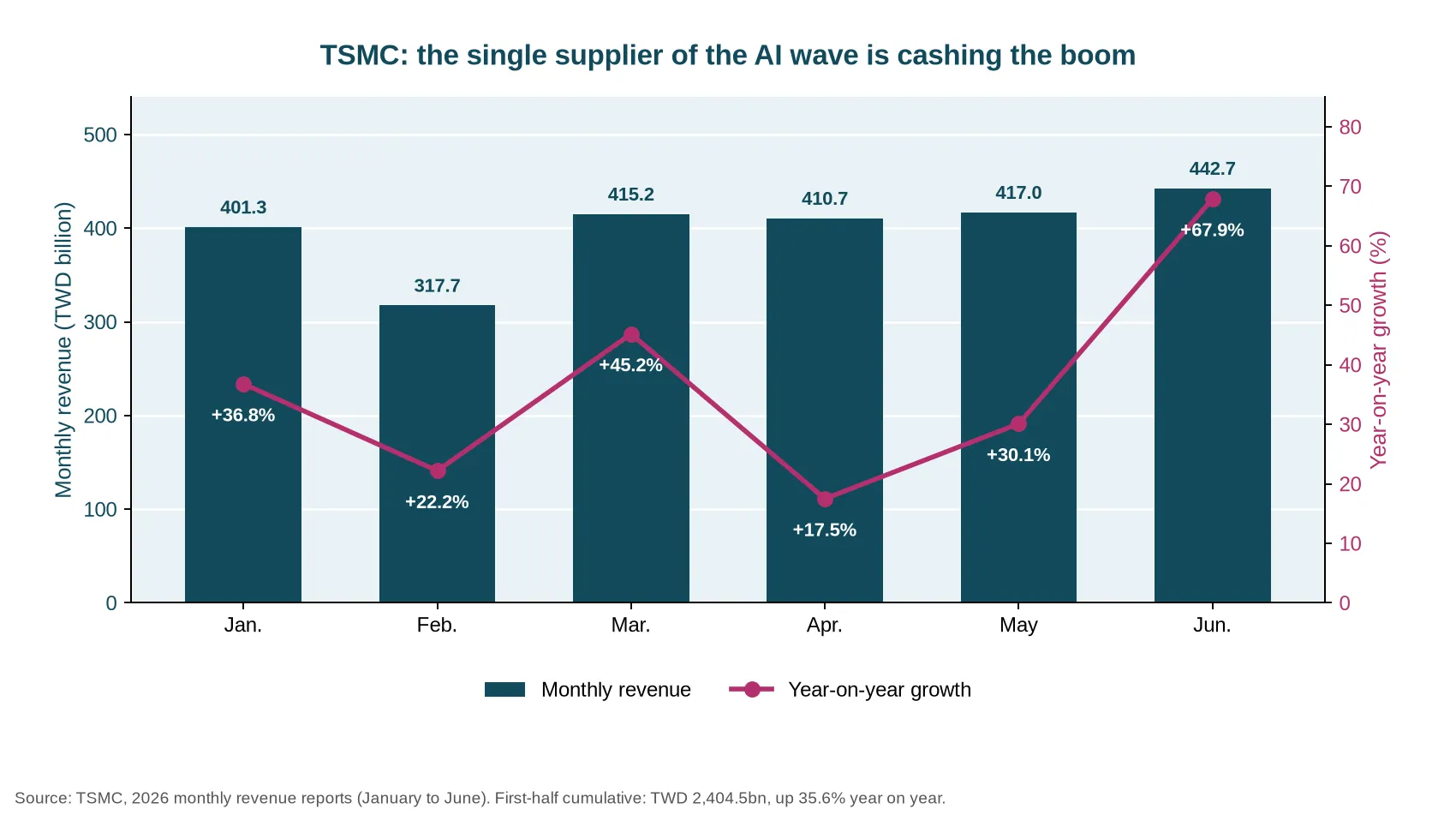
Taiwanese manufacturer TSMC, which produces most of the world's most advanced artificial intelligence chips, has published its June sales: TWD 442.7bn, up 67.9% year on year. Over the first half of 2026, revenue reached TWD 2,404.5bn, 35.6% more than a year earlier. There is no sign of deceleration.
Why it deserves your attention
This figure is not a corporate performance, it is a thermometer. TSMC sits at the bottleneck of the AI wave: when a cloud operator in the United States, China or the Gulf decides to build a data centre, the order ends up passing through its fabs. Its growth therefore measures global capital spending on computing power, several months ahead of official statistics.
The mechanism at work has a name: the investment accelerator. When demand accelerates, firms invest heavily to expand capacity, and that investment itself creates additional demand (plants, machines, hiring). The loop feeds itself as long as final demand keeps up. It reverses violently the moment it stops: investment does not slow down, it collapses.
Hence the only question that really matters. Does this revenue rest on uses that already pay for themselves, or on bets funded by debt and euphoria? A healthy expansion and a bubble trace exactly the same rising curve. What separates them is not the climb, it is how they end.
To understand the mechanism that turns an investment boom into a bubble, read the Fundamental “Economic cycles: recession, expansion and bubbles.”
You will learn the four phases of a cycle and where we currently stand, why the investment accelerator and the credit cycle amplify moves in both directions, and which leading indicators separate a healthy expansion from euphoria about to turn.
Read the Fundamental →