Battery overcapacity: 2,609 GWh approved in seven months
Beijing has frozen new battery plants after clearing, in seven months, more annual capacity than the country produced in a whole year. Behind the halt sits a plain mechanism: overcapacity is what manufactures falling prices, and correcting it by decree stops that fall early.

The fact
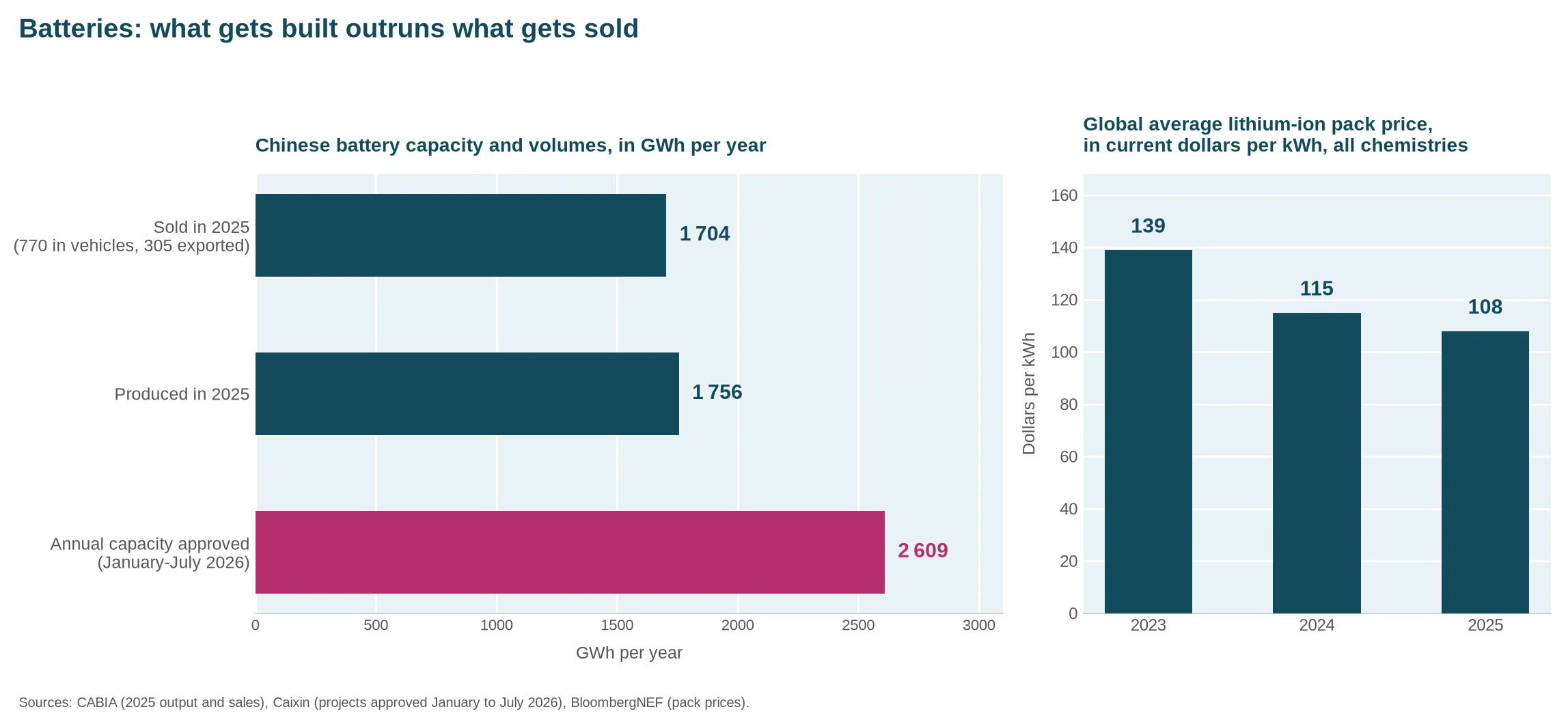
Beijing has suspended approvals for battery plants that have not yet broken ground, pending a review of planned capacity due by the end of the year. Projects already under construction carry on. The reason sits in two numbers: between January and July 2026, about a hundred expansion projects were cleared for 2,609 GWh of annual capacity, while China produced 1,756 GWh of batteries across the whole of 2025.
Why it matters
Capacity is not demand. Of that 2025 output, 770 GWh went into vehicles assembled in China and 305 GWh was exported; stationary storage absorbed most of the remainder, and sales tracked output closely, at 1,704 GWh. The imbalance is not in unsold stock: it sits in the plants still to be built. When a finished plant has to run to pay back its investment, it sells at the price that fills the line, not the price that covers its costs. That mechanism, as much as technical progress, pushed the global average lithium-ion pack price from 139 dollars per kWh in 2023 down to 108 dollars in 2025.
The stakes reach past manufacturers. The price of a stored kilowatt-hour sets the pace of electrification: every dollar off makes a storage fleet or a vehicle pay for itself sooner. Ending overcapacity by administrative decision rather than by bankruptcies protects producer margins, but it also cuts short the deflation buyers have been living on. Those buyers are everywhere: a pack already costs 56% more in Europe and 44% more in North America than in China.
To understand why a booming sector always ends up building more than it can sell, read the Fundamental: “Economic cycles: recession, expansion and bubbles.”
You’ll learn the five phases of the speculative cycle mapped by Hyman Minsky, the leading indicators that flag a turning point before prices do, and why overinvestment is the signature of every euphoric phase.
Read the Fundamental →


