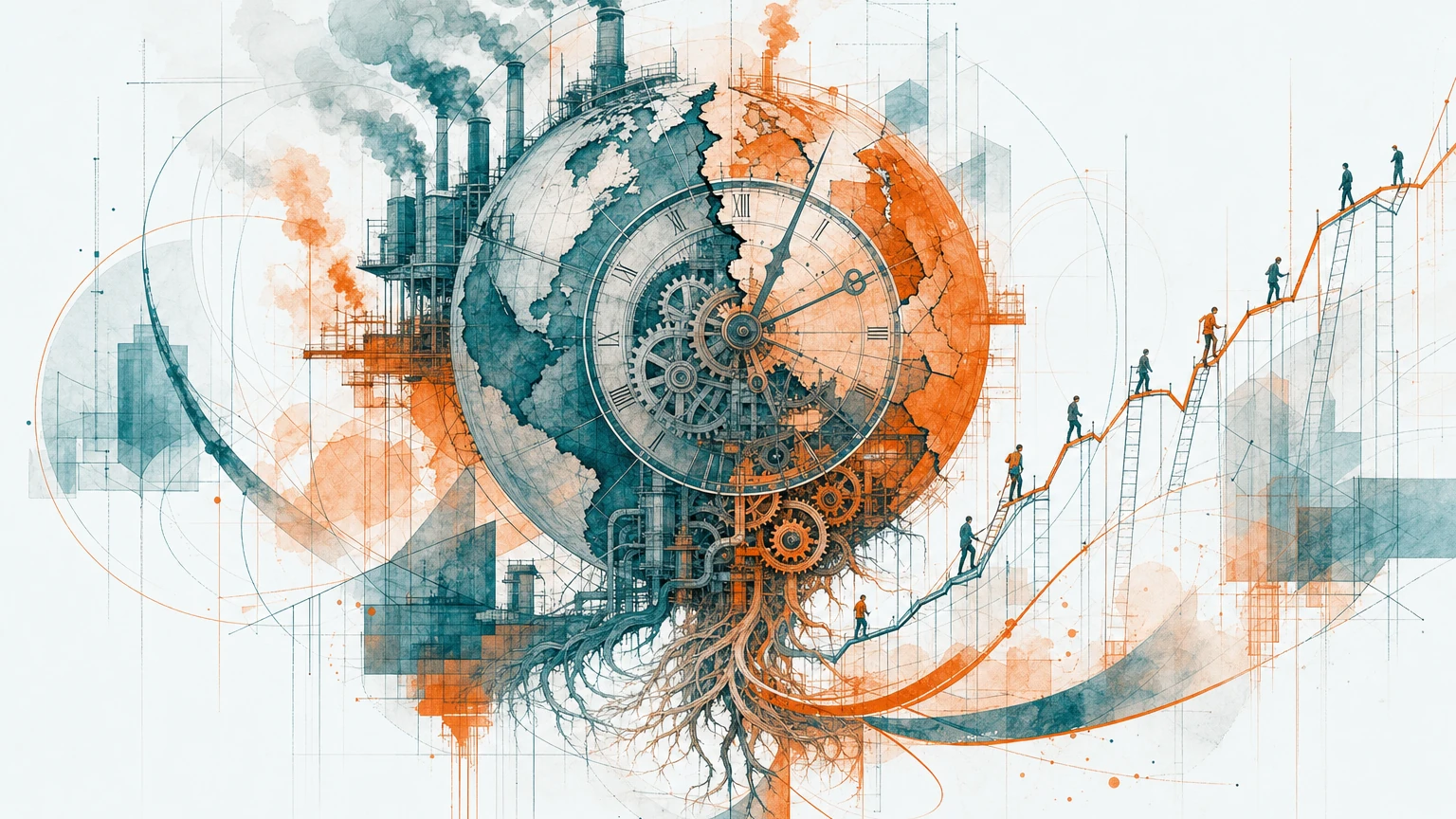
GDP has multiplied by more than tenfold in advanced economies since 1950. Yet forecasters now expect the next decades to look nothing like the last. What actually drives growth, why it slows, and whether the historical model can still hold, the foundational concepts behind every economic outlook.
Global GDP has grown tenfold since 1950. Nobody knows if it can keep going.
Productivity, Innovation, Demographics, and Ecological Constraints
Why Understanding Economic Growth Matters
Economic growth is at the heart of nearly every political, social, and environmental debate. Every day, media outlets announce growth figures, recession forecasts, or economic expansion targets. Governments base their budgets on growth assumptions. Companies plan investments based on growth prospects. Citizens hope that growth will create jobs and improve their living standards.
But what does economic growth really mean? Where does it come from? What are the drivers that enable an economy to produce more, year after year? And most importantly: can this growth continue indefinitely, or does it face insurmountable limits?
Understanding the sources and limits of economic growth is not just a technical question reserved for economists. It’s a fundamental key to grasping the challenges of our time: employment, inequality, ecological transition, technological innovation, and demographic aging. Without this understanding, it’s impossible to evaluate the relevance of proposed economic policies or participate in an informed way in public debates.
This fundamental will give you the foundations to understand: • What economic growth really is and how it’s measured • The four main sources of growth: productivity, innovation, demographics, and capital • How these sources interact and why some countries grow faster than others • The ecological, demographic, and structural limits that can slow or stop growth • The concrete implications of these mechanisms for your daily life and collective future
1. The Basics: What Is Economic Growth?
Economic growth refers to the increase in the production of goods and services in an economy over a given period. It’s generally measured by the evolution of Gross Domestic Product (GDP), which is the sum of all value added produced in a territory.
Concretely, 3% growth means the economy produced 3% more goods and services than the previous year. If an economy produces 1 trillion euros worth of wealth in one year, 3% growth means it will produce 1.03 trillion euros the following year.
Why is growth so important? For three fundamental reasons:
1. Employment: A growing economy generally creates more jobs than a stagnant economy. Companies invest, hire, and expand.
2. Living standards: In the long term, economic growth is the only way to sustainably increase average living standards. A country growing at 2% per year doubles its GDP per capita in approximately 35 years.
3. Investment capacity: A growing economy generates more resources to finance public services (health, education, infrastructure), repay debt, or invest in ecological transition.
Since the Industrial Revolution, the global economy has experienced historically unprecedented growth. Global GDP has been multiplied by 75 between 1960 and 2023, rising from approximately 1.4 to 105 trillion dollars.
We use audience-measurement (statistics) cookies to understand how the site is used. Cookies strictly necessary for the site to work are always on. Cookie policy
Cookie preferences
Choose which cookie categories you allow. Your choice is stored for six months and can be changed at any time.
NecessaryAlways on
Essential for the site to work: session, security, remembering your cookie choice. Always on.
Anonymous audience measurement (Google Analytics) to understand site usage and improve it.