Sydney falls, rents soar: Australia’s market splits
For the first time in the current cycle, home values are falling in Sydney and Melbourne, even as rents rise 5.9% nationally. Rates back at 4.35%, a tax shake-up for landlords, and a record low in consumer confidence: three forces behind a housing market that’s splitting in two.
The fact
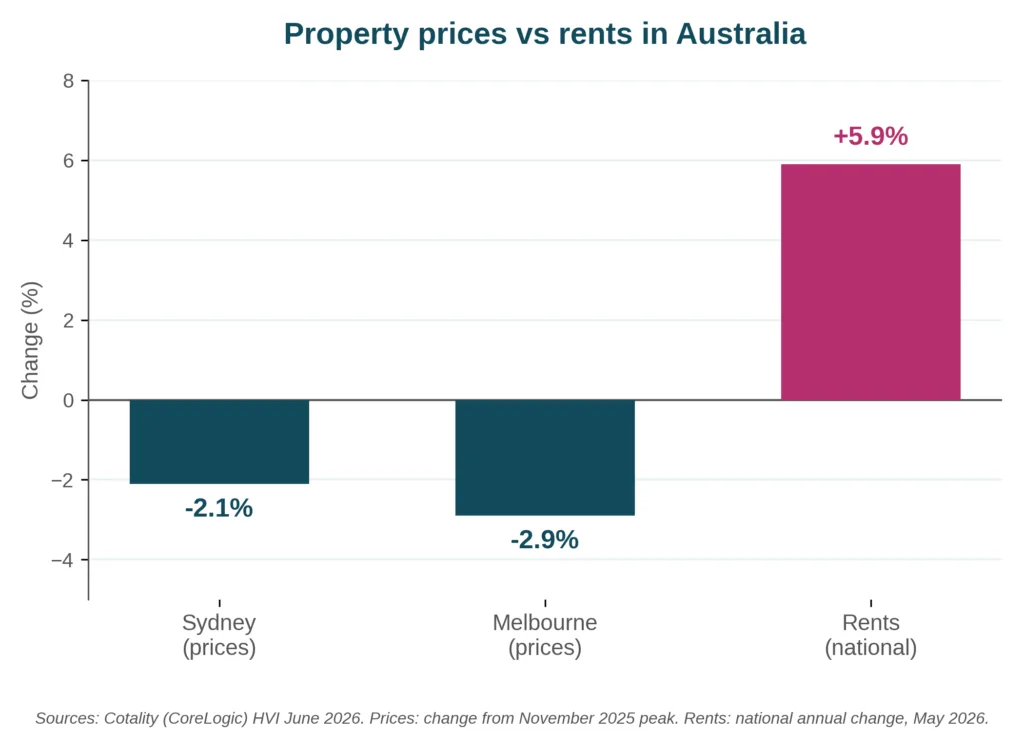
In a matter of months, Australia’s housing market has shifted. In Sydney, the median dwelling value has fallen 2.1% from its November 2025 peak. In Melbourne, the decline reaches 2.9%. The national home value index stalled at 0.0% in May 2026, something that hadn’t happened since the recovery cycle began. Yet rents are rising 5.9% year-on-year nationally, with the rental vacancy rate back at 1.5%, matching historical lows.
Why this matters
This isn’t a random correction. Three forces converged at once.
Australia’s central bank reversed course: after cutting rates three times in 2025 (75 basis points in total) the Reserve Bank of Australia raised them back to 4.35% in May 2026, a level its own board described as “slightly restrictive,” and held there in June. Interest rates are the single most powerful lever in housing markets: each extra percentage point on a 25-year, $200,000 mortgage adds roughly $25,000 to $30,000 in total repayment costs.
The federal government then proposed, in its May 2026 budget, to reform two pillars that had underpinned investor activity in the rental sector for decades: negative gearing (the ability to offset rental losses against taxable income) and the 50% capital gains tax discount. These measures, currently moving through Parliament, are expected to trigger a sharp pullback by investors in the established housing market.
Finally, consumer confidence collapsed to its lowest level since records began in late March 2026 (below even the pandemic-era low) driven by the combination of geopolitical uncertainty and the central bank’s rate hikes, according to the ANZ–Roy Morgan index.
The picture is not uniform. While Sydney and Melbourne were declining, Perth was still posting +26% year-on-year and Brisbane +20%. The correction is real, but it is concentrated in Australia’s two largest cities.
To understand how a property market can go from euphoria to correction in just a few months, read the Fundamental: “Real estate: bubbles, investment and housing policies.”
You’ll learn how to calculate what a single extra percentage point on a mortgage rate actually costs over the life of a loan, how to read the price-to-income ratio that signals an overheated market, and how to spot the difference between a healthy correction and a bubble about to burst.
Read the Fundamental →