US debt interest now tops the entire defense budget
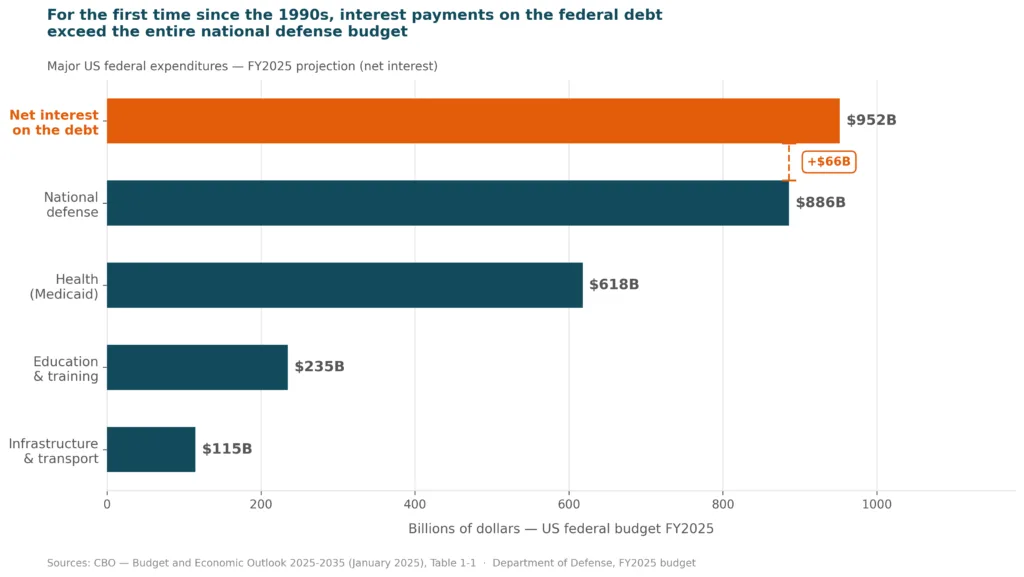
For the first time since the 1990s, US net interest payments on the federal debt exceed the entire national defense budget: $952 billion versus $886 billion. On May 16, 2025, Moody’s stripped the US of its triple-A, the last of the three major rating agencies to do so. A signal markets already knew. A mechanism most people have never seen explained.

On May 16, 2025, Moody’s cut the United States’ credit rating from Aaa to Aa1. Standard & Poor’s did the same in August 2011, Fitch in August 2023. For the first time in history, the US no longer holds a triple-A from any of the three major rating agencies.
Moody’s diagnosis is arithmetic. Federal debt now exceeds $36 trillion, roughly 122% of GDP. The annual deficit came in at 6.4% of GDP in 2024, and the CBO projects it at 6.2% in 2025.
But there is another number that changes everything. In 2025, net interest payments on the federal debt reach $952 billion, against $886 billion for national defense. For the first time since the 1990s, debt service exceeds the military budget.
Why it matters
This figure is more than symbolic. It illustrates a mechanism economists call the crowding-out effect: every dollar sent to creditors is a dollar that does not go to roads, hospitals, or research.
A credit downgrade is not a moral verdict. It is a signal about a country’s trajectory. Moody’s is not saying the United States will default, a scenario that remains highly unlikely, not least because the dollar remains the world’s reserve currency. In its statement, the agency writes that the downgrade reflects “the increase over more than a decade in government debt and interest payment ratios to levels that are significantly higher than similarly rated sovereigns,” and that “successive US administrations and Congress have failed to agree on measures to reverse the trend.”
In practice, a downgrade pushes up the rates at which the government borrows. Higher rates mean a heavier interest burden. And a heavier burden widens the deficit, which must itself be financed by new borrowing. The CBO projects net interest will cross $1 trillion as soon as 2026.
The question is not whether the United States can repay its debt. The question is how much of its budget it will have to sacrifice to service it, and for how long.
To understand how sovereign borrowing works, who actually holds US debt, and at what point a debt trajectory becomes a problem, read the Fundamental “Public Debt: How It Works and why it matters?”
Read the Fundamental →