Oil back above $100: anatomy of a worldwide supply shock
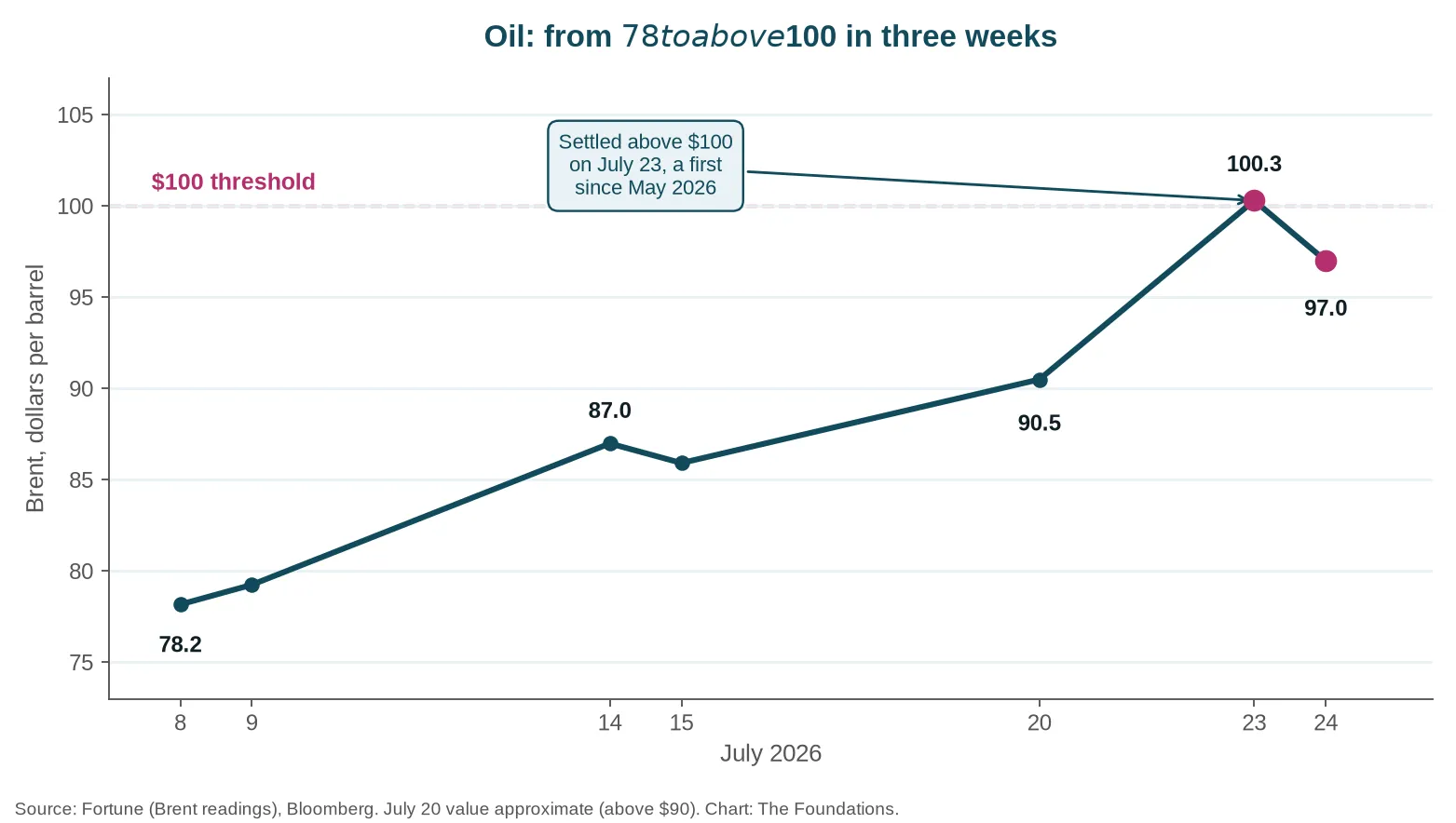
In three weeks, Brent crude climbed from 78 to more than 100 dollars a barrel before easing back toward 97. Drone strikes on the Black Sea, tanker attacks in the Red Sea, tensions around Hormuz: disruptions are stacking up. Behind the spike lies a precise mechanism: a market stripped of its shock absorbers facing demand that cannot adjust.

The fact
On July 23, Brent crude, the global oil benchmark, settled above 100 dollars a barrel for the first time since May. Three weeks earlier, it was still trading near 78 dollars. Even after easing back toward 97 dollars on July 24, the weekly gain reached 14.6 percent, driven by simultaneous supply disruptions on four separate fronts.
Why it deserves attention
No single incident explains a jump of this size. Drone strikes halted loadings of Kazakh crude at the Novorossiysk terminal on the Black Sea, more than 1 percent of world supply. In the Red Sea, two Saudi tankers were attacked and insurers are restricting war coverage. Around the Strait of Hormuz, the conflict between the United States and Iran threatens the busiest oil corridor on the planet.
The real mechanism lies elsewhere: the market’s shock absorbers (inventories, spare production capacity) are historically thin. Because demand cannot adjust in the short run, every barrel at risk commands a premium: small disruptions produce large price moves. Persistently expensive crude then spreads through everything, from fuel to freight and fertilizers. Rapidan Energy expects the barrel to end the year near 100 dollars.
To understand how an oil shock turns into a general rise in prices, read the Fundamental: “Inflation: mechanisms, causes and consequences.”
You’ll learn how cost-push inflation works, why the supply shocks of the 1970s still guide central banks, and how inflation expectations become self-fulfilling.
Read the Fundamental →