Bidding wars: how two buyers push an acquisition price up
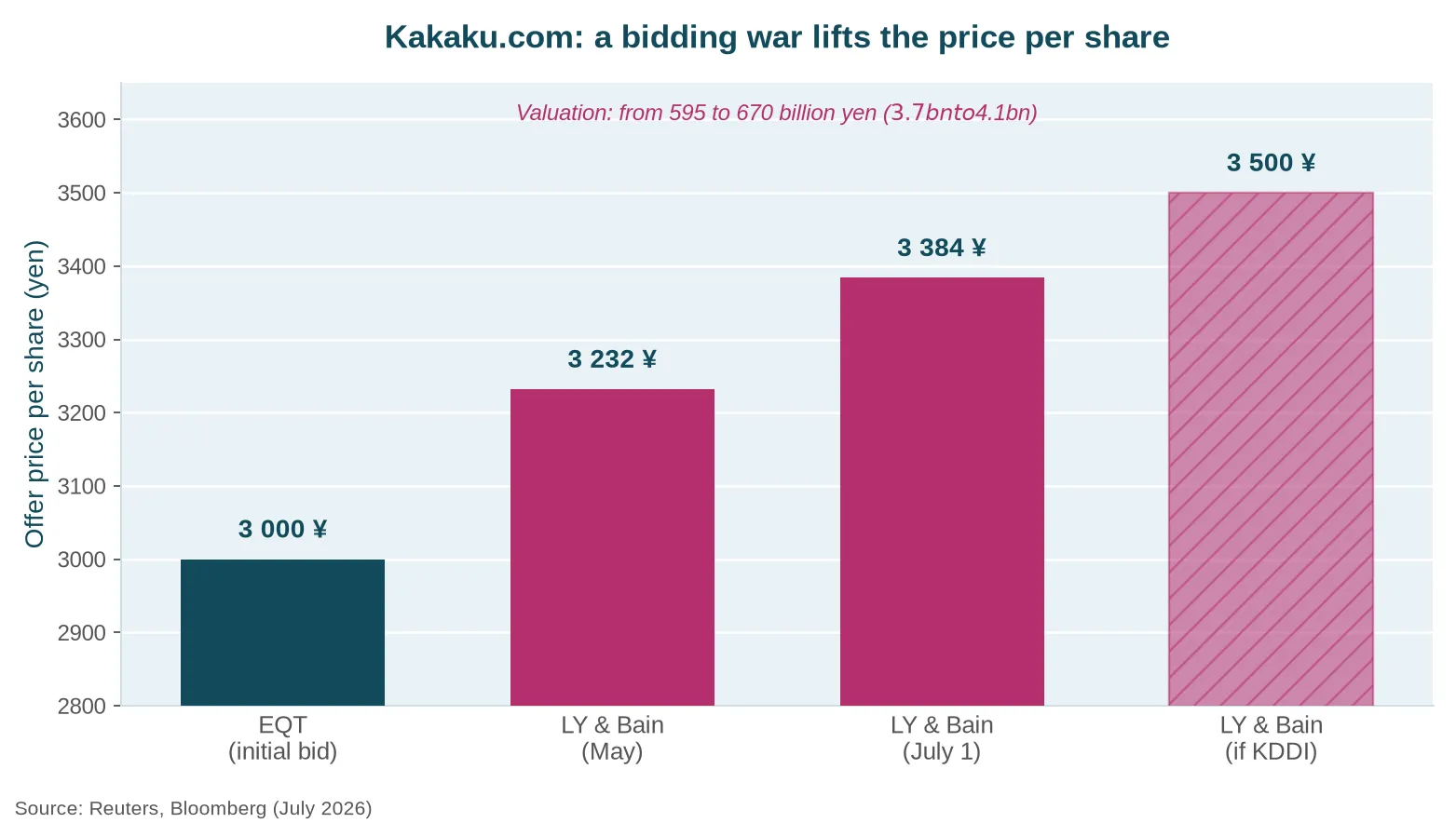
Since May 2026, EQT, LY and Bain have been fighting over Kakaku.com, a Japanese price-comparison site. Each round lifts the per-share offer, from 3,000 to nearly 3,400 yen, pushing the valuation from 3.7 to 4.1 billion dollars. A textbook case of the auction dynamics that drive takeovers.

The fact
Since May 2026, two camps have been fighting over Kakaku.com, one of Japan’s largest price-comparison sites. Sweden’s EQT opened the auction at around 3,000 yen per share. Japan’s LY (a SoftBank company) and US fund Bain Capital hit back, raising their bid to 3,384 yen, valuing the target at 670 billion yen ($4.1 billion). This week, EQT jumped back in front.
Why it matters
When several buyers want the same target, none can win without topping the previous offer. The price stops reflecting the company’s standalone value: it measures what the most determined acquirer will pay to seize control. That gap has a name, the control premium, and in a few weeks it added 75 billion yen to Kakaku.com’s valuation. LY justifies its aggressiveness by the target’s “extremely high strategic value” in the age of generative artificial intelligence.
The target’s board even withdrew its recommendation for EQT and turned neutral, letting both sides bid to maximise shareholder value. Then comes the classic trap: the winner of an auction is often the one who most overestimated the target, known as the winner’s curse. It is one reason most takeovers destroy value instead of creating it.
To understand why a bidding war so often destroys value instead of creating it, read the Fundamental: “Mergers and acquisitions: how M&A deals work.”
You’ll learn why most takeovers disappoint, what the control premium reveals about the price paid, and how markets judge a deal the moment it is announced.
Read the Fundamental →