Oracle: $55.7bn spent, and free cash flow at minus $23.7bn
Oracle has just posted record operating cash flow and, in the same fiscal year, free cash flow of minus $23.7 billion. Both numbers are accurate. The gap comes from one simple accounting rule, which the announced layoffs do not fix. Debt is what actually fills it.

The fact
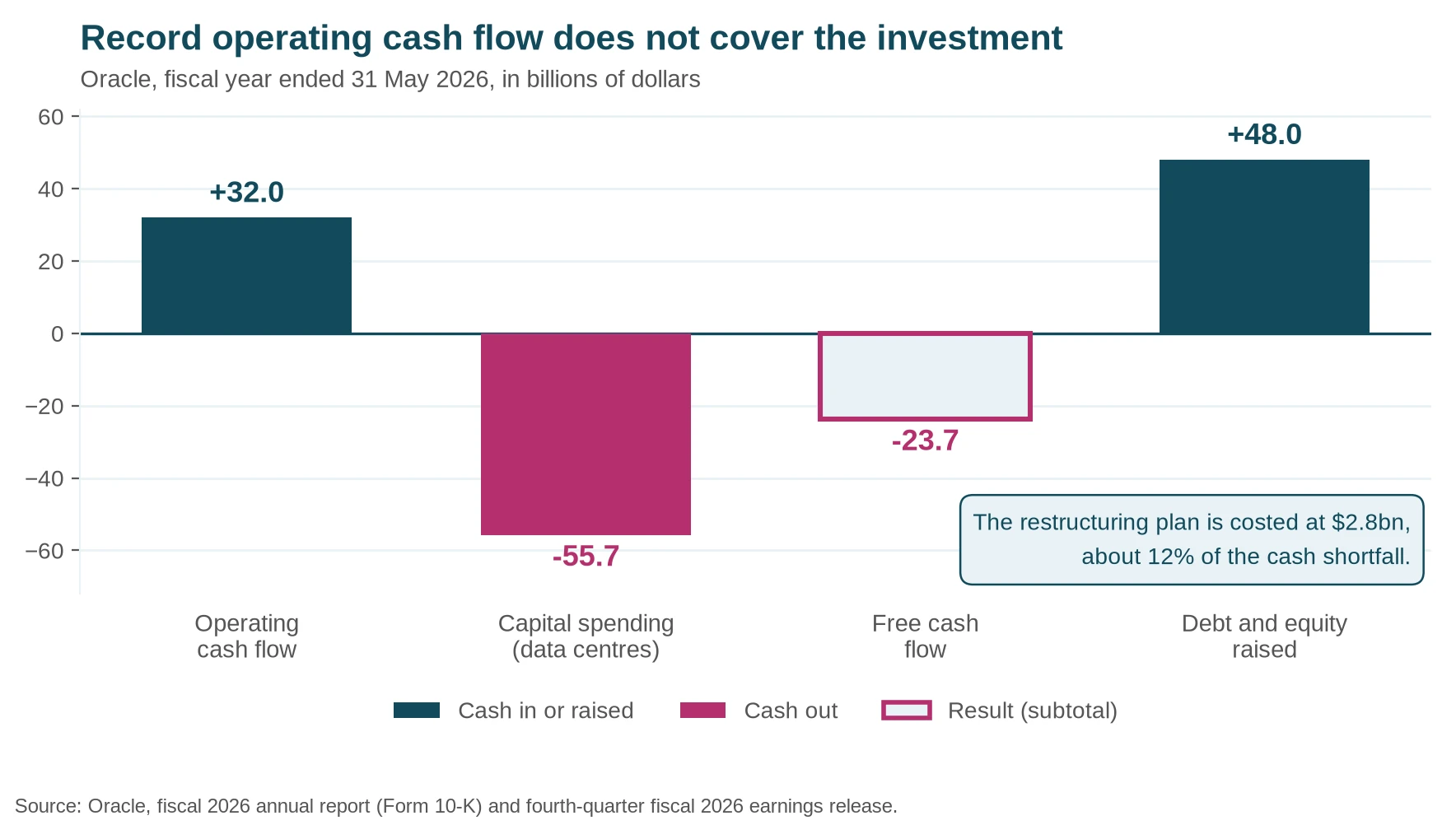
Oracle opened a fresh round of layoffs this week to help pay for its data centres. Yet the company has just reported record operating cash flow: $32.0 billion for the fiscal year ended 31 May 2026, up 54%. In that same year it spent $55.7 billion on capital investment, against $21.2 billion the year before. The subtraction leaves free cash flow at minus $23.7 billion.
Why it matters
Capital spending does not pass through the income statement. When a company buys servers, the outlay does not become an immediate expense: it becomes an asset, written down over several years. Reported profit therefore stays presentable while the cash has already gone. That gap is exactly what free cash flow measures, and it is why a record result and a $23.7 billion hole sit inside the same fiscal year. The rule holds under every major accounting standard, whatever exchange the company is listed on.
Salaries work the other way: they are an expense straight away. Cutting them improves the income statement immediately, which explains the reflex. But the orders of magnitude do not meet. The restructuring plan, costed in September 2026 at roughly $2.8 billion, comes to barely 12% of the hole, and it adds an outlay rather than a source of cash. What actually closes the gap sits elsewhere, on the financing line: $43 billion of debt and $5 billion of equity raised in the same year.
The stake is easy to name. The variable that gets adjusted is not the expensive one, it is the one that can be cut quickly. For employees, it means paying down an investment bill they did not run up. For investors and lenders, it means a rising profit says nothing about the ability to pay: only cash says that, and it is read on a different line of the same document.
To understand why profit and cash can diverge this far, read the Fundamental: “Profitability and value creation: reading a company.”
You will learn why EBITDA flatters the accounts by erasing depreciation, how to tell profit, which is an opinion, from cash, which is a fact, and at what point return on capital genuinely creates value instead of quietly destroying it.
Read the Fundamental →