AI stocks: the market reversal that revives bubble fears
After a 130% rally in a year, the semiconductor index plunges and money flees into other sectors. This is not just a market accident: it is the recurring mechanism by which an over-concentrated investment story always ends up reversing, often violently.

The fact
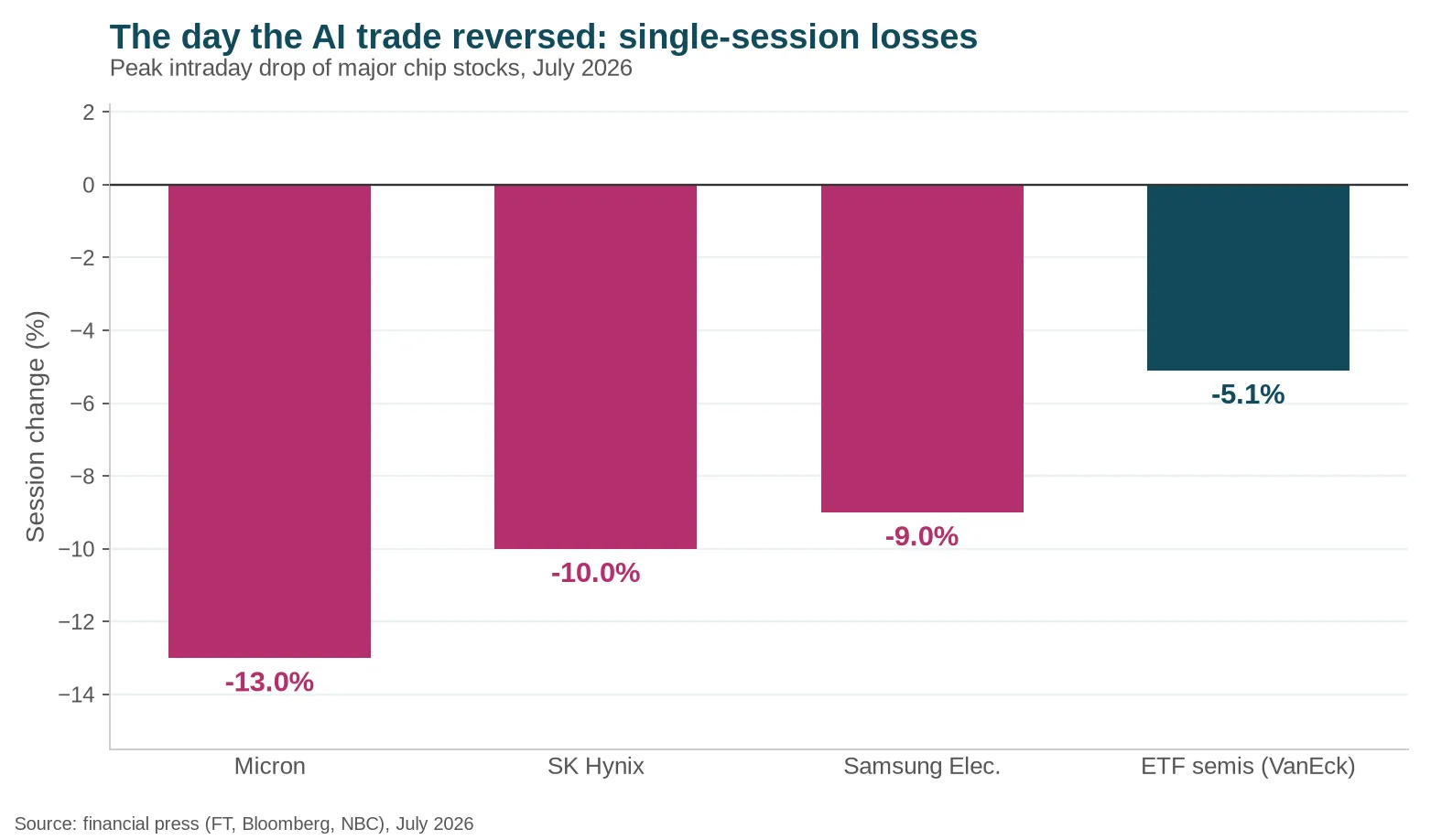
On 17 July 2026, the AI trade went into reverse. The semiconductor index, up nearly 130% over a year, sold off hard: Micron fell as much as 13% in a single session, and in Seoul the KOSPI dropped about 10%, tripping its circuit breakers, dragged down by Samsung and SK Hynix. According to the financial press, the money did not vanish: it left chipmakers for industrials, financials and defensive stocks, even as other major indices touched record highs.
Why this reversal is bigger than the market
The move has a name: sector rotation. When a single story, here AI, captures an outsized share of the world’s savings, prices rise less because companies create value than because everyone bets on reselling higher to the next buyer. The rise feeds on itself, until one small trigger flips the direction of the herd.
Economists call this a speculative bubble, and it always follows the same phases: enthusiasm, euphoria where "this time is different," then reversal. The dot-com bubble quintupled the Nasdaq before wiping out $5 trillion in 2000. None of this proves AI is a bubble of that scale, but the sharpness of a reversal, and the speed at which money switches sides, are exactly the signals worth reading rather than merely enduring.
To understand the mechanism behind this reversal, read the Fundamental: "Economic cycles: recession, expansion and bubbles."
You’ll learn to recognise the five phases of a bubble described by Minsky, why herd behaviour amplifies every cycle, and which leading indicators flag a turning point before it catches you off guard.
Read the Fundamental →