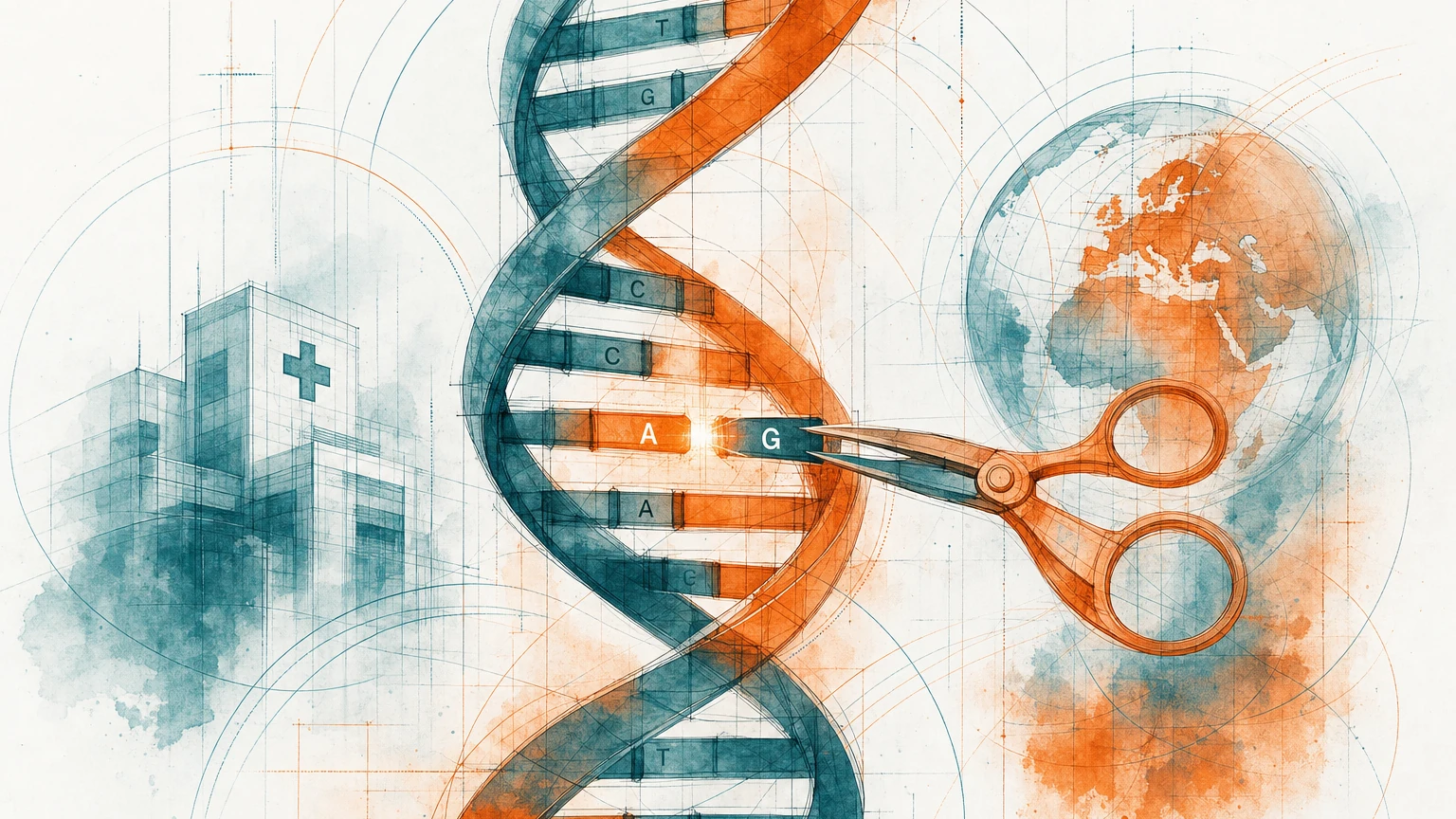
In December 2023, a health regulator approved a treatment that corrects a blood disease at its root. The therapy, named Casgevy, rewrites the patient's own DNA. Its outcome comes close to a permanent cure. Yet four patients out of five will likely never receive it.
The price reaches 2.2 million dollars per patient. Around 80 % of people with this disease, sickle cell disorder, live in sub-Saharan Africa. These are regions where health systems already struggle to fund basic care. Biotechnology has therefore crossed a historic threshold. It now treats diseases long considered incurable. But it raises a new question: what use is a cure that almost no one can pay for?
Understanding this tension means grasping three technologies reshaping medicine. They carry names that have become familiar without being understood: CRISPR, gene therapy and messenger RNA. This article explains these mechanisms from scratch. It then shows why they are shifting the frontiers of global health economics.
The basics to understand
From DNA to a living medicine
Every cell in the body contains DNA. This DNA is a long molecule that stores instructions. These instructions, the genes, tell the cell which proteins to build. A single error in one gene can trigger a serious disease. Sickle cell disorder stems from just one changed letter in the hemoglobin gene.
For a century, medicine treated the symptoms of such diseases. It compensated for the faulty gene without ever repairing it. Biotechnology now proposes the opposite. It acts directly on the genetic information, at the source of the problem.
The word biotechnology means using living systems to produce care. It covers very different tools. Three of them dominate today's medical news.
One distinction shapes everything that follows. Some approaches change the DNA permanently. Others act only briefly, leaving no trace in the genome. This difference drives the expected benefits, the risks involved and the final price of a treatment.
An old dream, long out of reach
The idea of repairing a gene is not new. The first gene therapy trials date back to the 1990s. They already sparked immense hope. But the technique remained unpredictable and sometimes dangerous.
In 1999, in the United States, a young patient named Jesse Gelsinger died during a trial. The viral vector had triggered a fatal immune reaction. This accident froze the field for nearly a decade. Researchers had to rethink vector safety and dose control.
Three advances later unlocked the field. Safer viral vectors were developed. The discovery of CRISPR brought unprecedented precision. Finally, the pandemic proved, at massive scale, the reliability of messenger RNA. These three building blocks make the present period very different from earlier ones.
CRISPR: programmable molecular scissors
CRISPR is a tool that cuts DNA at a precise location. It works somewhat like a find-and-replace function applied to the genome. Researchers give it a target sequence. The tool locates that sequence, cuts the strand, then lets the cell repair or edit the gene.
The name CRISPR comes from a mechanism seen in bacteria. They keep fragments of DNA from viruses they have already met. They use these fragments to recognize and destroy the same virus on a later attack. Researchers repurposed this natural defense system into an editing tool.
Two scientists, Emmanuelle Charpentier and Jennifer Doudna, described this use in 2012. They received the Nobel Prize in Chemistry in 2020. Within a decade, CRISPR moved from the lab to the patient's bedside. Casgevy is its first application authorized in humans.
In Casgevy, the editing does not happen inside the body. The blood stem cells are removed, corrected in the laboratory, then reinjected. This is called an ex vivo approach, as opposed to acting directly in the organism. The method limits risks but adds logistics and cost.
Gene therapy: delivering a healthy gene
Gene therapy pursues a different goal. It does not always edit the faulty gene. Instead it adds a working copy of the missing gene. A vector, often a virus made harmless, carries this gene into the cells.
This approach mainly targets rare diseases caused by a single gene. Hemophilia B, a clotting disorder, is one of them. A single injection can sometimes correct the defect for years. The promise is therefore a one-time treatment rather than a lifelong one.
Beta thalassemia, another blood disease, benefits from the same logic. It deprives the body of normal hemoglobin and forces lifelong transfusions. The therapy corrects the faulty production at its source. In many cases, the patient can then avoid those repeated transfusions.
Messenger RNA: giving a temporary instruction
Messenger RNA, or mRNA, works in yet another way. It does not modify DNA. It passes a short instruction to the cell. That instruction asks it to build a specific protein, then fades away.
The Covid-19 vaccines, authorized in late 2020, made this technology famous. They taught cells to produce a protein from the virus. The immune system thus learned to recognize the threat. The same logic now applies to other diseases, including some cancers.