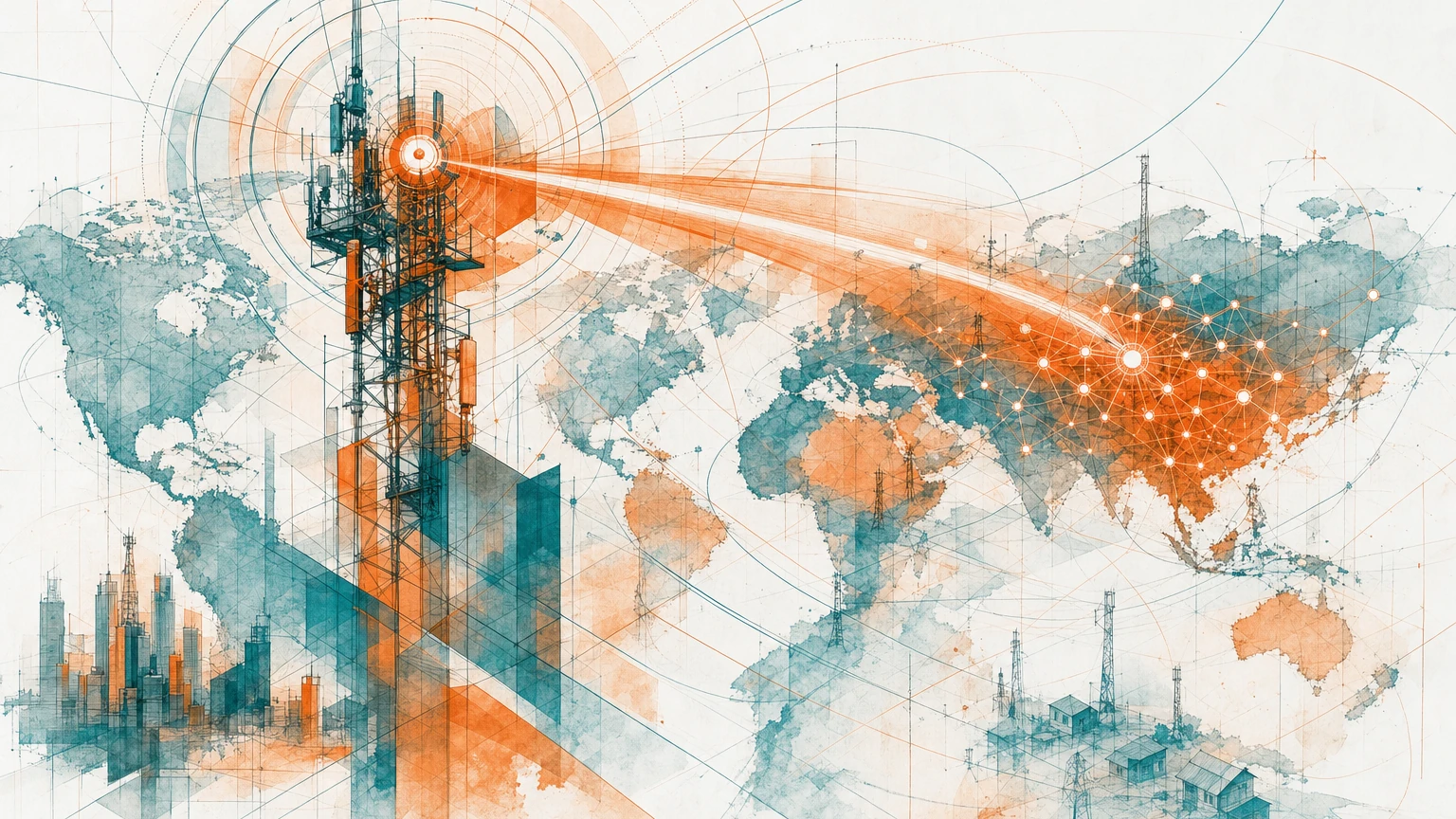
You were promised self-driving cars and connected factories. You mainly gained one extra letter on your screen. While China installs millions of antennas and two billion people stay offline, 6G is already being marketed to you. This Fundamental unpacks what 5G really changed, who benefits from it, and why the next generation arrives before the previous one kept its promises.
When 5G arrived in 2019, it came with a dazzling pitch: self-driving cars, remote surgery, factories run in real time. Six years later, most users mainly gained one extra letter on their phone screen. Meanwhile, another number quietly exploded. China had installed roughly 4.84 million 5G base stations by the end of 2025, while low-income countries offer the technology to just 4 percent of their people.
The real story of 5G is not about your download speed. It is about an invisible infrastructure that is redrawing the economic map of the world. It is also about a divide that keeps widening, even as the next generation is already being marketed to us. Understanding mobile telecommunications means understanding one of the nervous systems of the modern economy. Here are the basics, assuming nothing.
The basics you need
One generation per decade
A mobile network links your phone to antennas that connect it to the rest of the world. Each generation is a leap in what that link can do. 1G, in the 1980s, carried voice in analog form. 2G, in the 1990s, made it digital and invented the text message. 3G, around the year 2000, put the internet in your pocket. 4G, from 2010, made mobile video smooth and powered the smartphone era.
5G, commercially deployed since 2019, is not just a speed bump. It aims at three things at once: very high throughput, tiny latency, and the ability to connect millions of objects per square kilometre. Latency is the delay between the moment you tap and the moment the network responds. That figure, more than raw speed, is what makes a connected car or a remotely controlled machine possible.
These generations are not mere marketing labels. They are defined by a United Nations agency, the International Telecommunication Union (ITU). 3G is officially called IMT-2000, 5G is IMT-2020, and the coming 6G will be IMT-2030. Keep that vocabulary in mind: it explains why a new generation appears roughly every ten years, and why 6G is already dated before it exists.
We use audience-measurement (statistics) cookies to understand how the site is used. Cookies strictly necessary for the site to work are always on. Cookie policy
Cookie preferences
Choose which cookie categories you allow. Your choice is stored for six months and can be changed at any time.
NecessaryAlways on
Essential for the site to work: session, security, remembering your cookie choice. Always on.
Anonymous audience measurement (Google Analytics) to understand site usage and improve it.