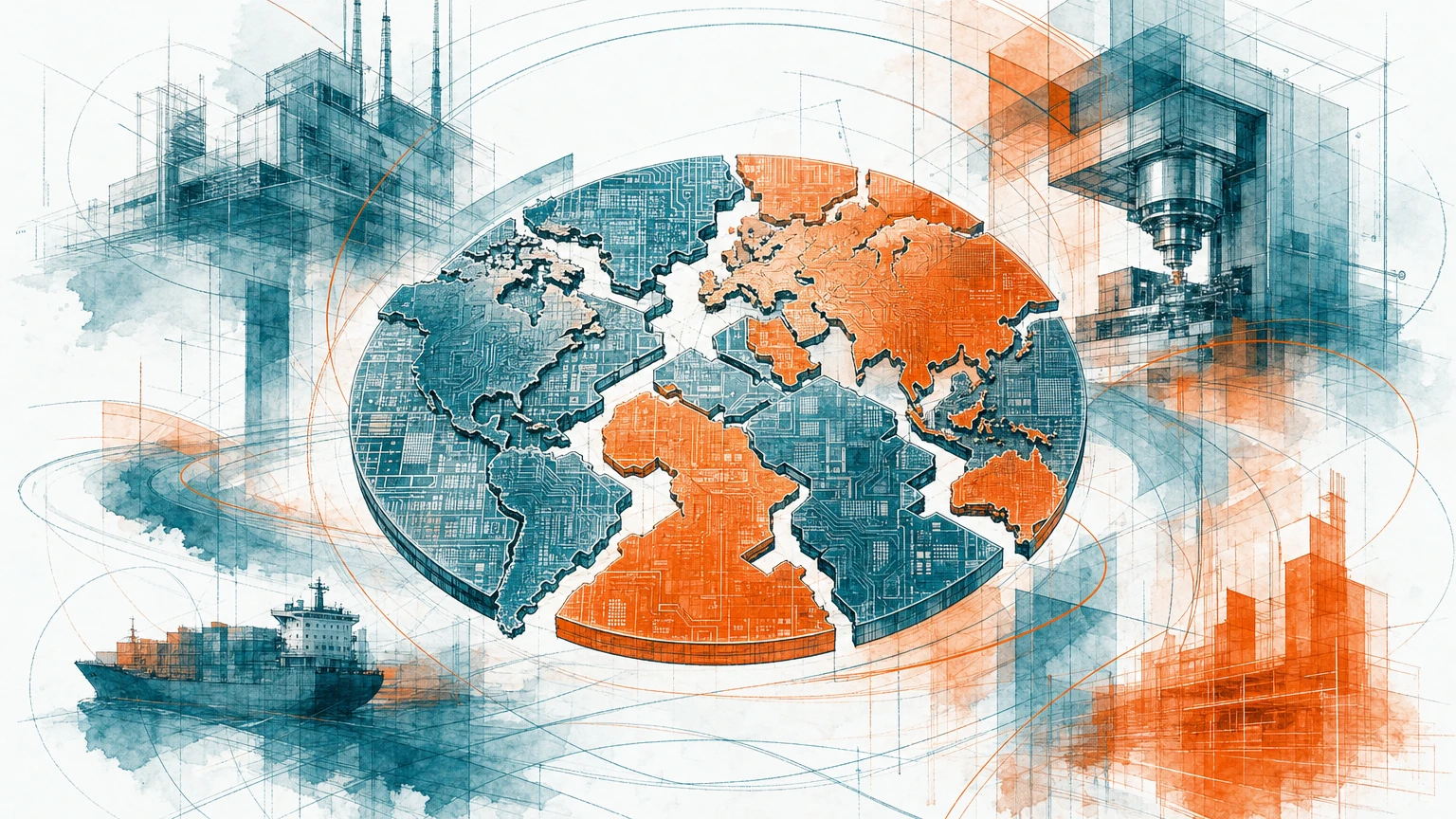
A single territory makes close to 90 % of the planet's most advanced chips, and no one can replace it quickly. Behind every smartphone, car and server hides a global chain of unexpected fragility. A 627-billion-dollar market, technical monopolies, a subsidy war: here is why chips now decide the balance of power between great nations.
One island makes 90 % of the most advanced chips, and the whole world depends on it
A single territory, smaller than many regions, produces close to 90 % of the planet's most advanced chips. If its factories stopped tomorrow, global output of smartphones, cars and servers would freeze within weeks. Yet most people could not name the company responsible. This invisible dependency now shapes the rivalry between the world's great powers. Semiconductors have become the most strategic object in global trade. They decide military strength, the lead in artificial intelligence and industrial sovereignty. Understanding why means opening a double black box, at once technological and geopolitical. This Fundamental offers a clear grid to finally read this silent battle. It starts from the raw material, climbs the global chain, then maps the balance of power. No prior knowledge is needed to follow the reasoning.
The basics you need
What a semiconductor actually is
A semiconductor is a material that conducts electricity better than an insulator, but worse than a metal. Silicon, extracted from sand, is the classic example. On a thin silicon wafer, engineers etch microscopic patterns that form transistors. A transistor is a tiny switch that lets current flow or blocks it. By combining billions of these switches, you obtain a chip, also called an integrated circuit. Depending on its architecture, the chip computes, stores or transmits information. Chips power phones, cars, servers, satellites and household appliances. Etching precision is measured in nanometres, a billionth of a metre. The finer the etching, the more transistors fit on the same surface. The chip then becomes more powerful and more energy efficient. A modern chip can hold over one hundred billion transistors on a fingernail-sized area.
Three families of chips to tell apart
Not all chips are equal, in use or in complexity. Three broad families are worth knowing. Logic chips compute and run instructions, like a computer's processor. Memory chips store information, whether temporary or lasting. Analog chips handle the physical world, such as sensors or power management. A second split separates advanced chips from mature ones. Advanced chips, etched below 7 nanometres, power premium smartphones and AI servers. Mature chips, coarser, sit inside cars, appliances and connected objects. These mature chips remain essential and make up most global volumes. The geopolitical battle, however, concentrates on advanced chips. They are the ones that condition military edge and artificial intelligence.
From American invention to Asian manufacturing
History explains today's geography. The first transistor was born in 1947 at Bell Labs, in the United States. The integrated circuit followed in the late 1950s, driven by Jack Kilby and Robert Noyce. In 1965, Gordon Moore stated a now-famous intuition. The number of transistors per chip would roughly double every two years. This Moore's law guided the industry for half a century. For a long time, American firms designed and manufactured their own chips. Then, from the 1980s, manufacturing migrated toward lower-cost Asia. In 1987, a novel model appeared in Taiwan with the creation of TSMC. This company designs no chip of its own, it only manufactures for others. That foundry model, or subcontracting plant, would reshape the entire industry. It separates design, highly profitable, from manufacturing, highly capital-intensive.
A value chain scattered across continents
Making a chip now mobilises dozens of countries. The chain splits into large specialised links, each dominated by a few players. Design comes first, drawing the chip's architecture. So-called fabless firms design without a plant, like America's Nvidia or Britain's Arm. Design software, known as EDA, comes from a handful of American companies. Then come the production machines, including light-based etching tools. Manufacturing itself concentrates in East Asian foundries. Finally, assembly and testing, called packaging, close the march. Each link is a potential chokepoint. A single blocked point can paralyse the entire global chain. This fragmentation explains why no country masters the whole process alone.
We use audience-measurement (statistics) cookies to understand how the site is used. Cookies strictly necessary for the site to work are always on. Cookie policy
Cookie preferences
Choose which cookie categories you allow. Your choice is stored for six months and can be changed at any time.
NecessaryAlways on
Essential for the site to work: session, security, remembering your cookie choice. Always on.
Anonymous audience measurement (Google Analytics) to understand site usage and improve it.