Helion bets $465M that fusion can leave the lab
Helion has just raised $465 million against a hard contractual deadline: deliver electricity to Microsoft by 2028. Nuclear fusion is no longer a laboratory project, but the industrial challenges remain entirely unsolved.

The fact
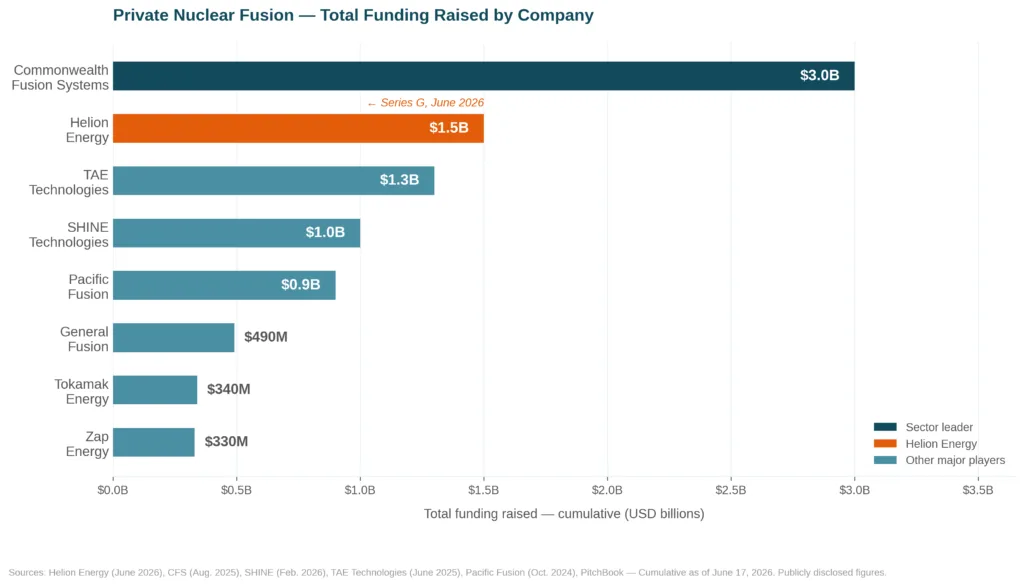
In June 2026, Helion Energy closed a $465 million Series G round, valuing the company at $15.5 billion. Four months earlier, its Polaris prototype had reached 150 million degrees Celsius, a world first for a privately developed fusion device. The startup now operates under a hard contractual deadline: deliver electricity to Microsoft’s grid by 2028.
Why this matters
What’s changing with Helion is the nature of the pressure. Nuclear fusion is no longer pulled forward by science alone, it’s being pulled by demand. Microsoft needs power for its data centers, OpenAI is reportedly in talks to secure a share of future output, and investors are betting an additional $465 million on a timeline that many engineers consider unrealistic.
Fusion promises near-unlimited energy, with no fossil fuels and no long-lived radioactive waste. But between a 150-million-degree plasma and a kilowatt-hour on an invoice, there are engineering challenges no one has yet solved at industrial scale. Helion is simultaneously building a miniature test device to iterate faster, which says a lot about the unknowns that remain.
Orion, the first commercial plant, is due to connect to the grid by end of 2028.
To understand how nuclear fusion produces energy, why it has proven so difficult to harness, and what still separates today’s prototypes from a commercial power plant, read the Foundational “Nuclear Fusion: State of the Art and Commercial Horizon.”
Read the Foundational →