Hormuz shut: 8.8 million barrels of bypass for 21
Drones launched from Iraq forced Saudi Arabia to shut its East-West pipeline, which had become its main export route since the Strait of Hormuz effectively closed. The interrupted volume matters less than what it reveals: the relief meant to offset a fifth of world oil consumption rests on a handful of pumping stations.
The fact
Saudi Arabia has shut its East-West pipeline after drones launched from Iraq damaged pumping stations in the Riyadh and Medina areas. The line runs from the oilfields of the Gulf coast to the Red Sea port of Yanbu. Its purpose was never to export more: it was to let crude leave without passing through the Strait of Hormuz. With the strait now effectively closed, that backup role has become the main artery.
Why it matters
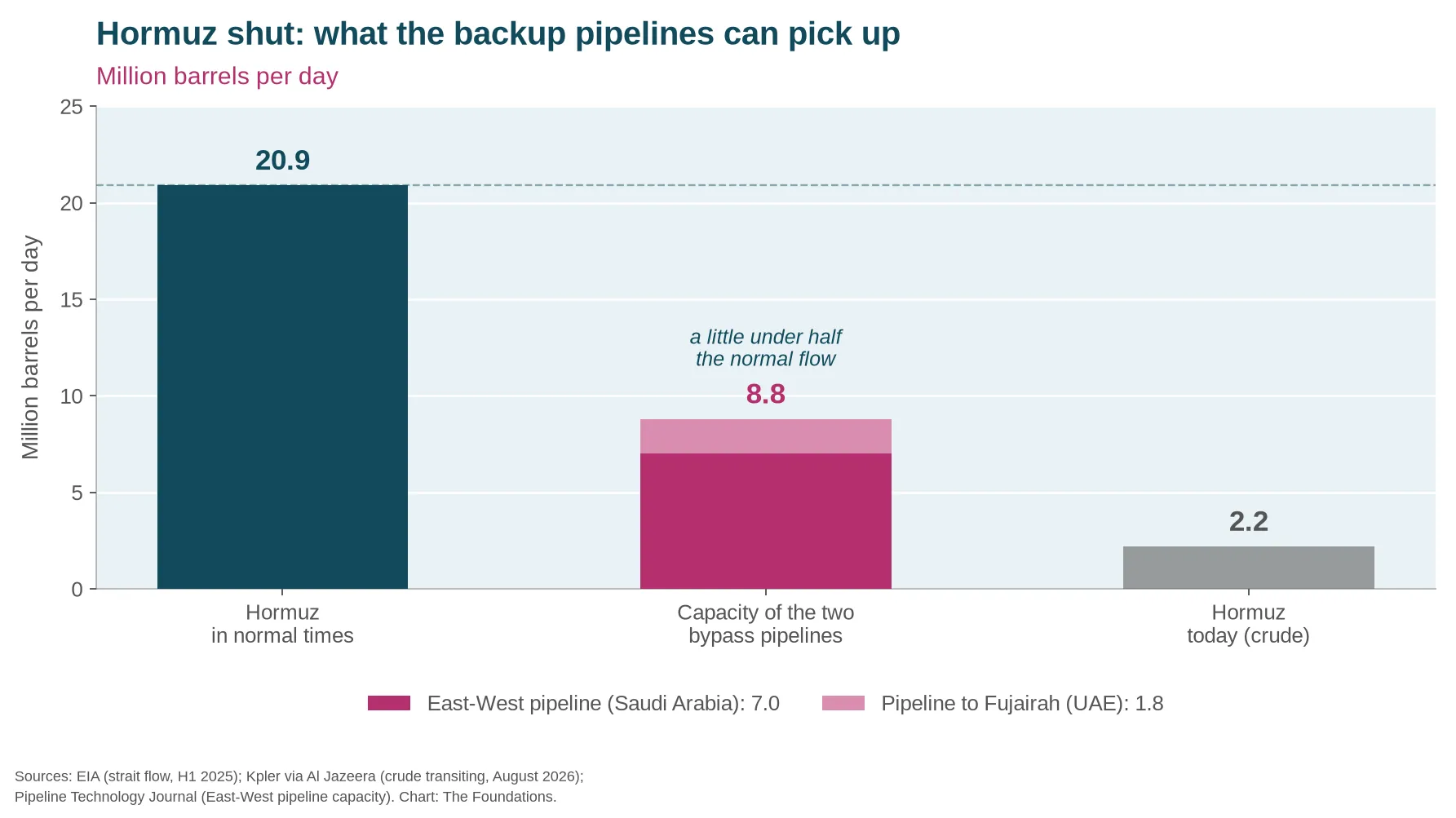
In normal times close to 21 million barrels a day of crude and refined products moved through Hormuz, a quarter of all seaborne oil trade. The strait is now shut in practice: crude still going through it has fallen to around 2 million barrels a day. Against that gap, the only two bypass routes in service are capped: the Saudi line at 7 million barrels a day, and the Emirati pipe to Fujairah at about 1.8 million. Even running flat out, they pick up a little under half the original flow.
Here is the mechanism: a backup counts as insurance only if the backup itself is out of reach. The East-West line crosses 1,200 kilometres of desert and depends on a handful of pumping stations, each one a single point of failure. It is already running at the ceiling of its capacity, so there is no slack to absorb a loss. A drone costing a few tens of thousands of dollars is enough to bite into the relief meant to offset a fifth of world oil consumption.
The stake does not sit first with Gulf producers. It sits with refiners and importers across Asia, where close to nine-tenths of this crude is headed, and then with every consumer downstream of them. The risk premium no longer waits for Hormuz to close, which has already happened: it now triggers every time the fallback route turns out to be within drone range too.
To understand why a handful of transit points sets the world price of a resource, read the Fundamental: “Natural resources: control, scarcity and geopolitics.”
You’ll learn how resources are spread across the world and what that imposes on importing countries, why their prices are structurally volatile, and how a local incident turns into a global energy bill.
Read the Fundamental →