Rare earths: why China still controls the world’s magnets
Despite the 2025 trade truce, Chinese magnet exports to the United States remain about a fifth below their pre-trade-war level. Behind that figure sits a quiet mechanism: a country’s power over a resource is decided not in the ground, but in the plant that transforms it.
The fact
A year after the trade truce meant to normalise commerce, China still ships roughly 20% fewer magnets to the United States than it did before the trade war. These magnets, invisible to most, spin electric motors, wind turbines and weapons systems. Washington reads the shortfall as Beijing honouring the deal to the letter, but not in spirit.
Why it matters
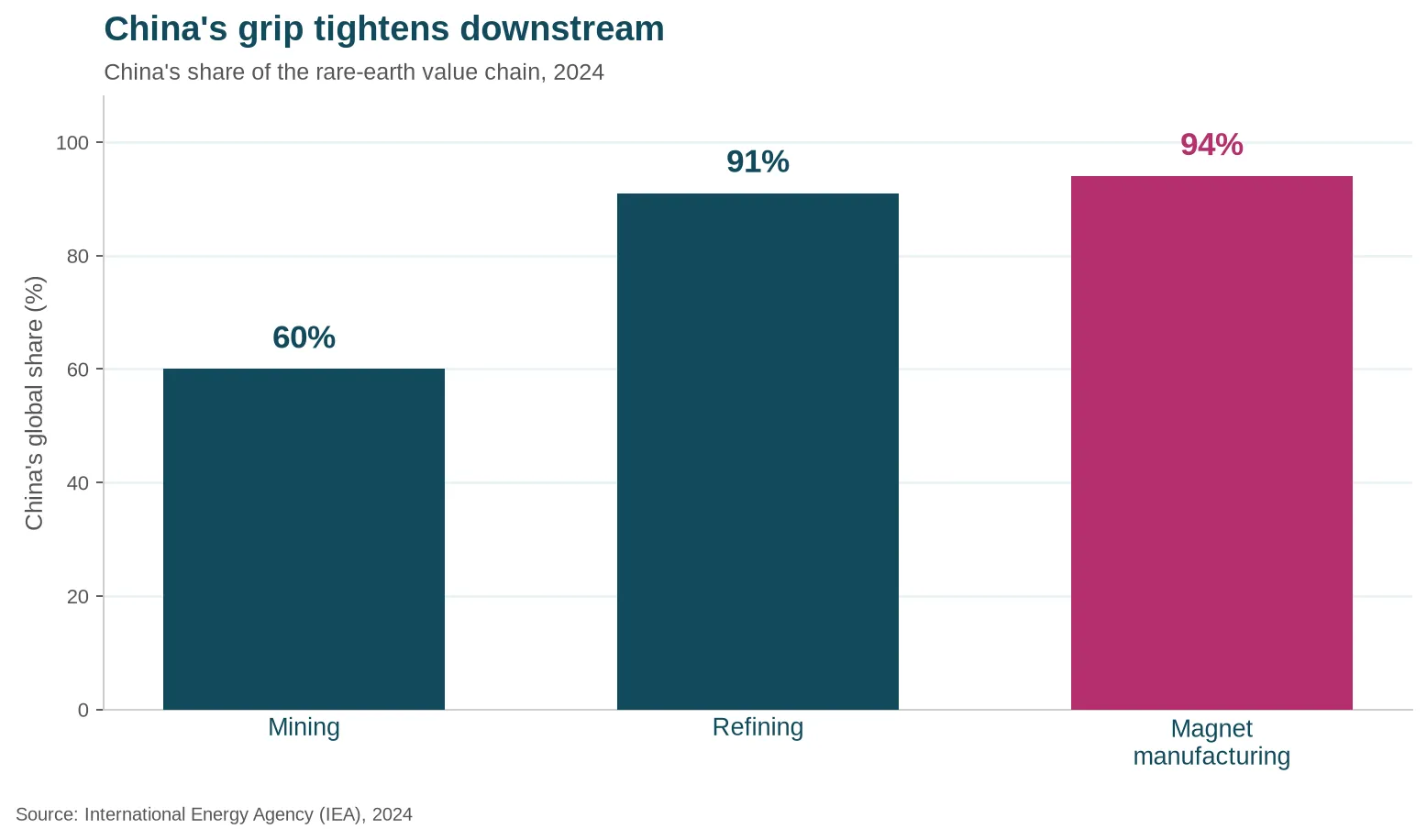
A country’s power over a resource is measured not by what it pulls from the ground, but by what it transforms. China mines only 60% of the rare earths used in magnets, a large but shared share. It refines 91% of them, however, and manufactures 94% of the world’s permanent magnets (International Energy Agency, 2024). The further down the chain you go, the tighter its grip. The leverage sits in the plant, not the mine.
That bottleneck turns a trade flow into an instrument of pressure. By slowing deliveries without ever cutting them, a dominant supplier reasserts its centrality while keeping the agreement intact. The precedent is well known: in 2010, China suspended rare-earth exports to Japan during a territorial dispute, sending some prices soaring. No substitute exists in the short term, and opening a mine and then a refinery takes ten to fifteen years.
The lesson runs well beyond rare earths. Lithium, cobalt, refined silicon: wherever a handful of plants concentrate the processing stage, whoever owns them owns a tap. Supply security no longer depends on who holds the deposit, but on who controls the least visible step.
To understand why control over a resource becomes a weapon, read the Fundamental: “Natural resources: control, scarcity and geopolitics.”
You’ll learn why certain materials became matters of national security, how refining rather than extraction distributes power, and why the energy transition is redrawing the global balance of power.
Read the Fundamental →