Why modern democracies erode from within, not by a coup
Armenia's ruling party wins again, the opposition warns of a democracy hollowed out from within. The case is not isolated: 44 countries are now autocratizing, many of them former democracies. Understanding how a regime tips without a coup, legally, is key to reading world affairs.

The fact
In Armenia, the ruling party won the June 2026 election with nearly 50% of the vote, yet the opposition and several observers warn of a democracy hollowed out not by force, but from within its own institutions, as Foreign Policy reports. The case reflects a global tilt: for the second year in a row, the planet holds more autocracies (92) than democracies (87).
Why it matters
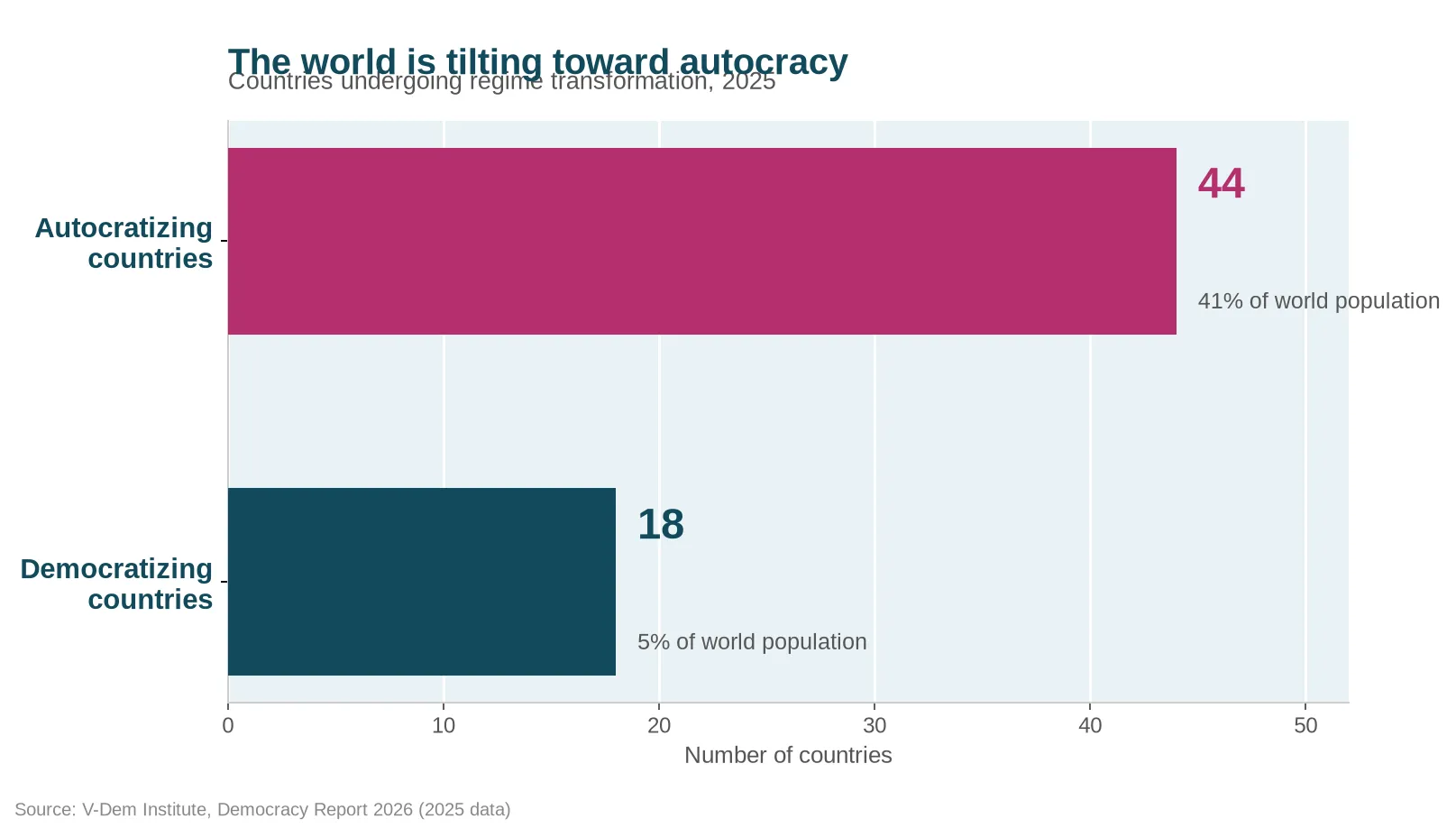
Democracy no longer retreats the way it did in the twentieth century. It rarely falls to tanks: it erodes legally, election after election, reform after reform. An elected leader weakens the checks and balances, muzzles the press and rewrites the voting rules, without ever suspending the constitution. In 2025, the V-Dem Institute counts 44 countries sliding into autocracy, against just 18 moving toward more democracy. The imbalance is striking: those 44 countries are home to 41% of the world's population, a record, while the other 18 hold only 5%. More telling still: of those 44 countries, 28 were democracies when the decline began, and 15 have already tipped into autocracy. Today, 74% of humanity, roughly 6 billion people, lives under an autocratic regime. From the United States, downgraded in 2025 to an electoral democracy, to Europe where several states wobble, understanding this mechanism means learning to read every contested election differently.
To understand the mechanism behind this news, read the Fundamental: "Political systems and democracy."
You'll learn to tell apart the four main regime types, to gauge the scale of the global democratic retreat, and to spot how a democracy can hollow out without ever changing its constitution.
Read the Fundamental →