China adds 3 years of work, the world will follow
On January 1, 2025, China raised its official retirement age for the first time in 70 years. It won’t be the last country to do so, and the mechanism driving that decision is the same one reshaping pension systems on every continent.

The fact
On January 1, 2025, China did what it had been putting off for 70 years: it raised the retirement age. Men will move gradually from 60 to 63, women in managerial roles from 55 to 58, and blue-collar women from 50 to 55. The transition runs over 15 years. Behind the move: 297 million Chinese citizens are now over 60, making up 21% of the population. Without reform, the national pension fund was projected to run dry before 2035.
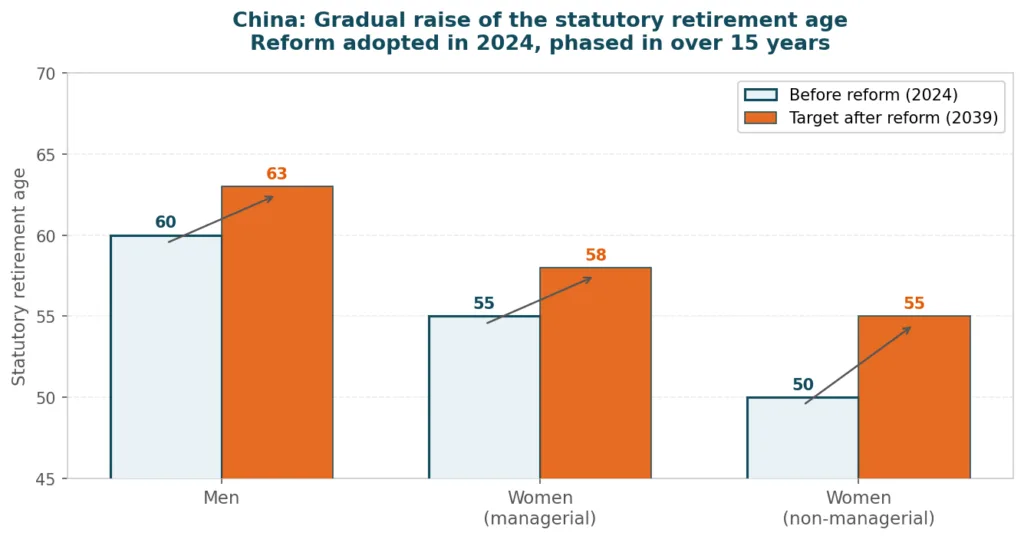
Source: National People’s Congress of China, September 2024
Why it deserves your attention
Pay-as-you-go pension systems rest on a simple piece of arithmetic: the contributions of today’s workers pay for the pensions of today’s retirees. That balance holds only as long as the ratio of workers to retirees stays stable, and everywhere that ratio is collapsing. In 1960 there were 7.2 workers for every retiree worldwide. Today it is 4.0. By 2050, UN projections put it at 2.8, and below 2.0 in the most advanced economies.
China is an extreme case. Its ageing is accelerated by the demographic aftermath of the one-child policy, in force from 1980 to 2016. Its fertility rate has fallen to around 1.0, far below the replacement level of 2.1: the most lopsided equation of any country its size.
Every pension reform, anywhere, pulls on the same three levers: the retirement age, the level of benefits, and the contribution rate. There are no others. The question is never whether these adjustments will happen, but who absorbs them and when.
The reform is not popular. It has drawn a wave of criticism over intergenerational fairness and the fate of older manual workers, hard to employ past 55 in a labour market where large firms often sideline staff from age 35. That paradox is not unique to China: Japan and several southern European countries face the same tension between a higher statutory age and the real employability of older workers.
From 2030, Beijing will also raise the minimum contribution period required for a full pension, from 15 to 20 years by 2040. Age and duration adjusted at once to close the same structural gap.
To understand why raising the retirement age becomes unavoidable when a population ages, read the Fundamental: “Retirement systems: demographics, funding and reform.”
You’ll learn how pay-as-you-go and funded systems really work, why the ratio of workers to retirees drives everything, and what levers (age, contributions, benefits) governments can actually pull.
Read the Fundamental →