Germany’s pensions don’t add up: enter Sweden
Germany is debating a structural overhaul of its pension system, drawing on the Swedish model. What’s at stake in Berlin is not a simple parametric fix, it’s a question of whether a pay-as-you-go system can still absorb an accelerating demographic squeeze.

The fact
Germany’s independent pension commission has submitted recommendations for a structural overhaul of the country’s retirement system, drawing on the Swedish model. The proposal: introduce a mechanism that automatically adjusts pension payouts based on life expectancy, and add a funded component to a system whose public pillar runs on pay-as-you-go financing, where today’s workers’ contributions directly fund today’s retirees.
Why this matters
This is not about tweaking the dials. Germany is considering changing the fundamental logic of how it funds retirement, not just adjusting the parameters within the existing system.
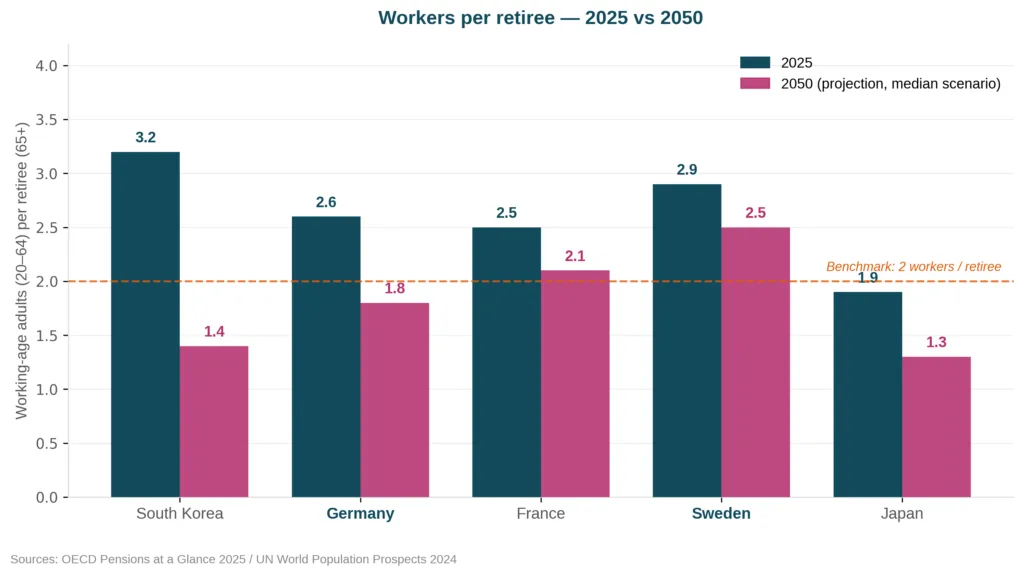
The demographic pressure is forcing the issue. Germany currently has roughly 2.6 workers for every retiree. UN projections put that ratio below 2 by 2050. In a pay-as-you-go system, that arithmetic leaves only three options: higher contributions, lower benefits, or a later retirement age.
Sweden’s model, cited as the reference, has offered a fourth path since 1998: a mechanism that automatically adjusts pension levels based on each generation’s life expectancy. The longer retirees live on average, the lower the monthly pension adjusts to keep the system solvent. No political vote required, no painful reform campaign: the arithmetic handles it.
What Berlin is examining is precisely that shift in logic.
To understand why every pay-as-you-go pension system faces the same arithmetic squeeze (and what distinguishes a parametric adjustment from a systemic reform) read the Fundamental “Retirement Systems: Demographics, Funding, and Reform.”
You’ll be able to read any future pension reform through the lens of the three available levers, identify the three risks specific to funded systems that pay-as-you-go absorbs collectively, and understand why the Swedish model is considered one of the most resilient in the face of demographic ageing.
Read the Fundamental →