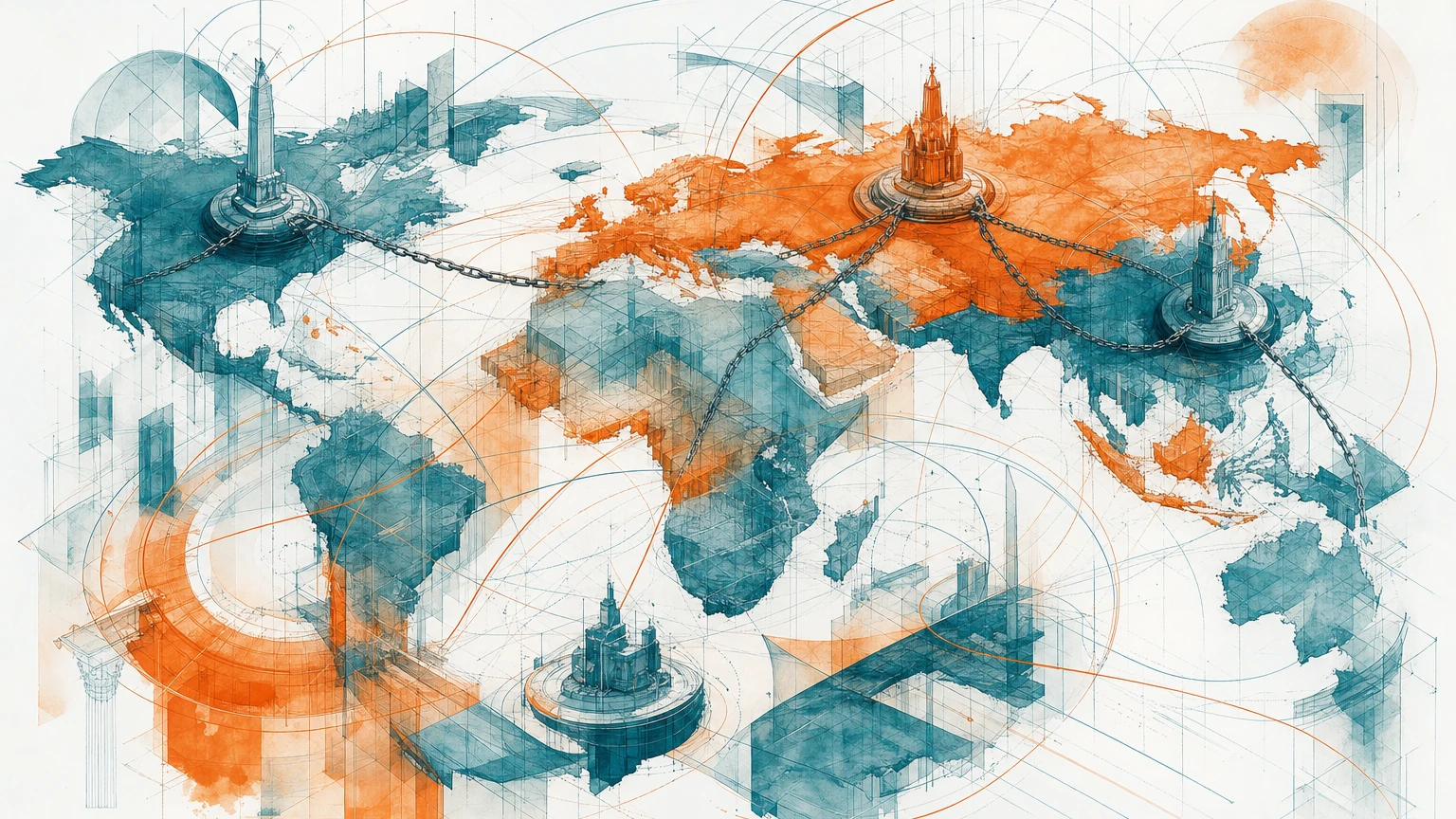
Global geopolitics: the forces that shape the world
Every conflict, every trade dispute, every alliance makes more sense once you understand the underlying geography, interests, and power dynamics. A structured framework for reading the international order, from great-power competition to regional flashpoints, without a degree in political science.

In 1956, two empires folded in days. The mechanism that broke them hasn’t changed.
The forces shaping the world order
Introduction: Why Geopolitics Concerns Everyone
In 1956, US President Eisenhower publicly refused to back France and the United Kingdom during the Suez Crisis. Within days, both colonial powers were forced to withdraw from Egypt under combined pressure from Washington and Moscow. A single decision made in the United States had been enough to redraw the lines of global influence. Geopolitics had announced itself with brutal clarity.
Seventy years later, the logic has not changed. When China announces export restrictions on gallium and germanium (two metals essential to semiconductor manufacturing) global stock markets react within hours. When tensions rise in the South China Sea, shipping companies recalculate their routes. Geopolitics is everywhere, even when it hides behind a single line in a diplomatic communiqué.
Geopolitics is the discipline that studies the relationships between states, territories, resources, and the resulting power dynamics. It answers one fundamental question: why do states act the way they do? Why do some go to war? Why do others cooperate, even when their interests diverge?
What you will understand after reading this Fundamental:
- What national power really means, and how it is measured
- Why physical geography continues to deeply influence political decisions
- How the three major current conflict zones took shape historically
- Which cross-cutting forces (technology, energy, migration) are reshaping the balance of power
1. The Foundations: Understanding Power and the International Order
1.1 The Three Forms of Power
We commonly speak of “great powers” to describe important countries. But what actually makes a state powerful?
Hard power refers to the capacity to coerce: armies, economic sanctions, nuclear arsenals. It is raw power, the kind that imposes itself through force or the threat of force. During the 1962 Cuban Missile Crisis, John F. Kennedy imposed a naval blockade around the island to prevent the installation of Soviet missiles. That is hard power at its most direct: the credible threat of force, without a single shot fired.
Soft power (a concept developed by political scientist Joseph Nye in the 1990s) refers to the capacity to attract and persuade: culture, political model, language, universities, exported standards. When millions of young people around the world wear Nike sneakers, watch American TV series, and dream of studying at Harvard, the United States is exercising a form of soft power without historical precedent. China has taken note: it has opened more than 500 Confucius Institutes worldwide and invested tens of billions across Africa and Southeast Asia to build its image as a reliable partner.
Smart power is the strategic combination of both. The European Union offers an instructive example: it has virtually no collective military hard power, yet its regulatory soft power is immense. This has been called the “Brussels Effect”, multinationals worldwide adopt EU standards on data protection or the environment not because they are required to do so at home, but because maintaining a single global standard is simply more efficient.

Figure 1, The five components of national power compared (analytical index, 2024)
1.2 The Major Theories of International Relations
Three broad schools of thought compete to explain state behaviour, and each illuminates different facets of current events.
Realism holds that states are rational actors whose primary goal is survival in an anarchic world, one with no government above them. In this view, alliances are instrumental and temporary. Henry Kissinger, one of its foremost practitioners, did not hesitate to support authoritarian regimes in the name of American national interest. This framework explains why states can cooperate on certain issues while competing fiercely on others.
Liberal internationalism argues, conversely, that states can cooperate durably when it serves their mutual interest. It highlights the role of international institutions (the UN, WTO, IMF) and economic interdependencies as forces for peace. The “McDonald’s argument” (the idea that two countries with a McDonald’s would never go to war) was popular in the 1990s. It took a blow in 2022 with the Russian invasion of Ukraine: Russia and Ukraine were deeply economically interdependent. That was not enough to prevent conflict.
Constructivism emphasises the role of identities and national narratives. Why did Finland (which had shared a 1,300-kilometre border with Russia for decades without seeking NATO membership) apply to join the Alliance in 2022? Because the invasion of Ukraine radically reshaped Finnish perceptions of the Russian threat. That was an identity shift, not a geographic one.
| Key takeaway: three levels of analysis • Systemic: the structure of the international system (unipolar, bipolar, multipolar) • State-level: the specific characteristics of each country (regime type, economy, national history) • Individual: the role of leaders and their personal perceptions, sometimes decisive |
1.3 The International Order: Rules, Institutions, Norms
International relations are not pure chaos. They are organised around an international order built after 1945: state sovereignty, non-interference, peaceful settlement of disputes, trade liberalisation. This order was largely conceived and promoted by the United States, which explains why powers that feel excluded from it are challenging it today.
Since the 2010s, this order has come under growing pressure. In 2015, China created the Asian Infrastructure Investment Bank, an alternative to the Bretton Woods institutions, which it felt gave it insufficient weight. Russia invokes the right to a “sphere of influence” to justify its actions in Ukraine. These challenges do not necessarily signal the end of all order, but they mark a transition toward a world where the rules of the game are increasingly contested.
2. Geography and Power: When the Map Shapes Destiny
Physical geography does not mechanically determine history, human agency and political decisions retain their own force. But geography sets constraints and opportunities that states do not choose. Five major geographic blocs structure global geopolitics.
2.1 The Eurasian Heartland: The Continental Mass as Fortress
In 1904, British geographer Halford Mackinder formulated his famous thesis: “Who rules Eastern Europe commands the Heartland. Who rules the Heartland commands the World-Island. Who rules the World-Island commands the world.” The Heartland refers to the core of Eurasia, an immense continental bloc inaccessible to maritime powers.
Far from being a historical curiosity, this theory still explains Russia’s deep-seated fear of encirclement: Russia is a land power that has always viewed Western military alliances near its borders as an existential threat. It also illuminates China’s Belt and Road strategy: by building land infrastructure across Central Asia and into Europe, Beijing seeks to assert its mastery of the Heartland. Mackinder’s idea, now over a hundred and twenty years old, continues to shape decisions made in Moscow and Beijing today.
2.2 Seas and Straits: Who Controls the Routes Controls Trade
The American naval officer Alfred Mahan argued the opposite: the supremacy of sea power. Controlling the seas means controlling world trade. The United States built its power on this principle, today operating eleven carrier strike groups capable of projecting force across every ocean. No other navy in the world operates more than two.
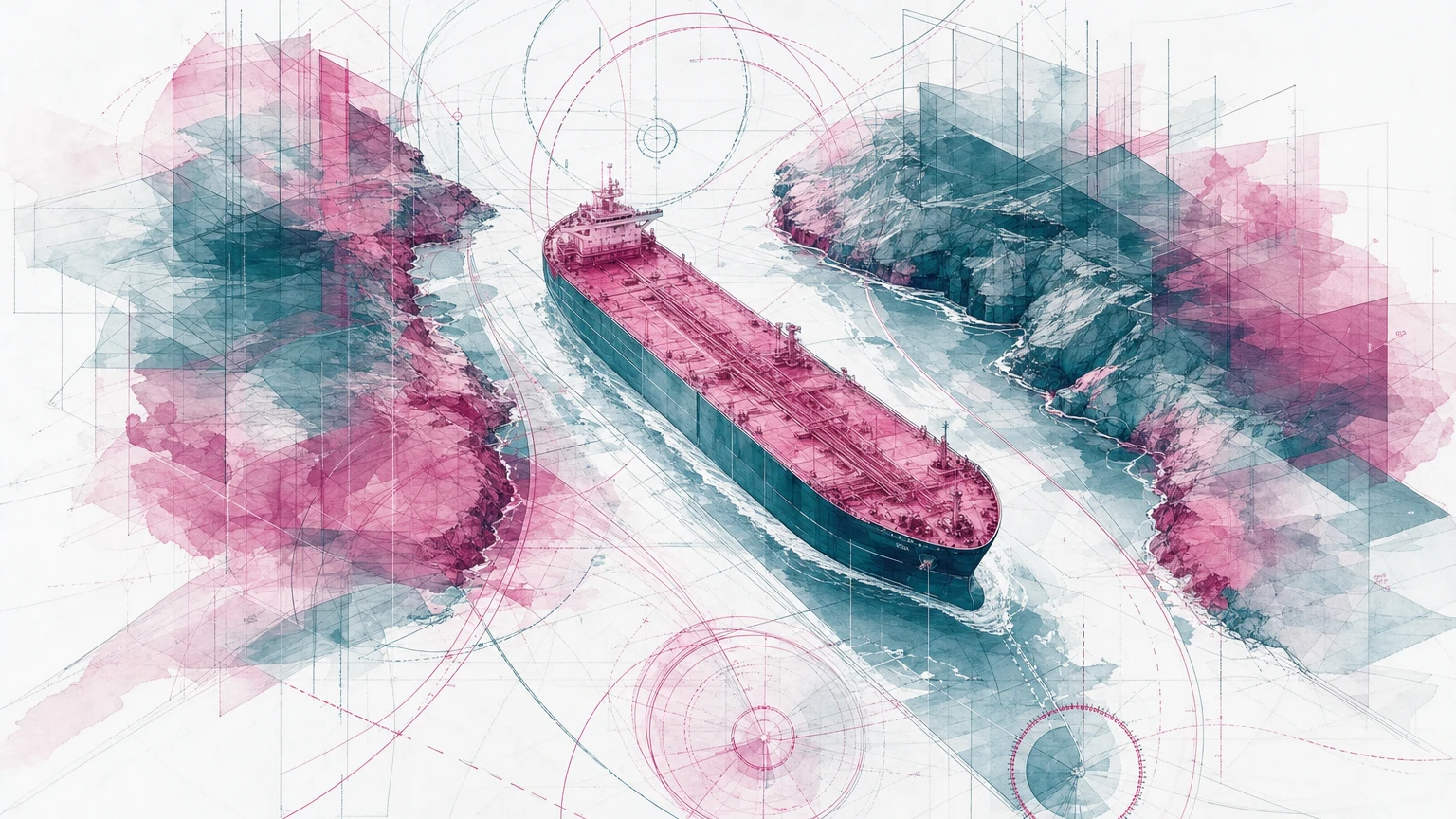
A handful of straits and canals punch well above their geopolitical weight. The Strait of Hormuz, between Iran and the UAE, is the mandatory passage for 20% of the world’s oil supply, even a brief closure would send energy prices soaring. The Strait of Malacca, between Malaysia and Indonesia, handles 40% of global trade, including the bulk of China’s energy imports. This “Achilles’ heel” has long preoccupied Beijing and explains its massive investment in alternative Indian Ocean ports. The Taiwan Strait, just 180 kilometres wide, is another chokepoint: Chinese control of it would give Beijing an unprecedented strategic lever over global supply chains.
2.3 The Middle East and Africa: Resources and Vulnerabilities
The Middle East holds 48% of the world’s proven oil reserves and 40% of its natural gas reserves. This concentration has made it the region with the highest number of external interventions since 1945. Africa, meanwhile, is rising in geopolitical importance for a different reason: it holds roughly 70% of global cobalt reserves, a metal essential for electric vehicle batteries. The Democratic Republic of Congo alone produces more than 70% of the world’s cobalt, amid chronic political instability that makes it a strategic vulnerability for major industrial powers.
Sub-Saharan Africa has thus become a theatre of growing rivalry among external powers: the United States, China, France, and since 2020 Russia via the Wagner Group, are competing for diplomatic, economic and military footholds in a region whose mineral resources are essential to the global energy transition.
2.4 The Indo-Pacific: Asia as the World’s New Centre of Gravity
The Asia-Pacific region now accounts for 38% of global trade and is home to the world’s two largest economies. The concept of the “Indo-Pacific” (which extends the analytical frame from the Pacific to include India and the Indian Ocean) has progressively replaced “Asia-Pacific” in American, Australian and Japanese strategic documents. It reflects the recognition that the most structurally significant power dynamics of the 21st century are playing out across this vast geographic arc.
China, whose entire eastern seaboard is largely encircled by islands and US allies (Japan, South Korea, the Philippines, Australia), seeks to break what it calls the “island chain” by asserting its presence in the South China Sea, the East China Sea, and by building land corridors toward the Indian Ocean through Pakistan and Myanmar.
2.5 The Arctic: The New Geopolitical Frontier
Climate change is opening a new geopolitical theatre: the Arctic. The melting of polar ice is gradually freeing up maritime routes (the Northeast Passage along Siberia, the Northwest Passage along Canada) that would significantly cut distances between Asia and Europe. It also opens access to subsea resources estimated to hold 30% of the world’s undiscovered natural gas reserves. Russia, with its immense Arctic coastline, has invested heavily in military capacity in the region since 2014. China, which has no Arctic coast, nevertheless declares itself a “near-Arctic state” and is seeking a foothold in the zone. A new front of geopolitical competition is taking shape, still without clear legal frameworks.

Figure 2, Geographic distribution of strategic resources worldwide (2023)
3. Major Contemporary Dynamics
3.1 From Unipolarity to a Multipolar World
On 25 December 1991, Mikhail Gorbachev announced his resignation and the Soviet flag was replaced by the Russian flag over the Kremlin. The USSR ceased to exist. Political scientist Francis Fukuyama had published a landmark essay two years earlier: The End of History. Liberal democracy and market capitalism had definitively triumphed.
It was wishful thinking. The 2010s brought great-power rivalry roaring back. China doubled its GDP roughly every seven years for three decades. Russia, humiliated in the 1990s, chose confrontation over integration. India, Brazil, Turkey, and Gulf states are asserting growing strategic autonomy. The world is now multipolar (multiple power centres coexist and compete) without this multipolarity having yet settled into a stable new order.
This transition is one of the most dangerous phases in geopolitics. Historian Graham Allison documented what he calls the “Thucydides Trap”: of the sixteen cases of hegemonic transition identified over the past five centuries, twelve ended in war. The rise of a rival power generates anxiety in the dominant power that can escalate into conflict that no one originally intended.

Figure 3, GDP of major economic powers (2023)

Figure 4 (Global military expenditure) Top 10 (2023)
These two charts capture the essential structure of global power. Economically, the United States remains first ($27.4T) but the gap with China ($19.4T) has narrowed considerably, China represented barely 12% of US GDP in 2000, versus 71% today. Militarily, the United States maintains an overwhelming lead at $916 billion in spending, more than the next nine countries combined. Yet China is building the fastest military build-up since World War II. These two tensions (economic convergence, persistent military gap) lie at the heart of the three major conflict zones that follow.

Figure 5, Chronology of the three major contemporary zones of tension
3.2 The Middle East: A Century of Fractures
From the Origins to the Cold War (1916–1990)
To understand the contemporary Middle East, one must go back to 1916. In the midst of World War One, two diplomats (British official Mark Sykes and French counterpart François Georges-Picot) quietly carved up the region into spheres of influence. Straight-line borders were drawn with a ruler across maps, with no regard for ethnic, tribal, or religious realities. Iraq was left uniting Arab Shia, Arab Sunni, and Kurdish populations within a single state, an explosive configuration whose effects have never ceased.
In 1948, the creation of the State of Israel triggered the first Arab-Israeli war. The Israeli victory forced the exodus of 700,000 Palestinians, the Nakba, or “catastrophe,” in Palestinian collective memory. This was followed by the Six-Day War (1967) (in which Israel tripled its territory in six days by capturing the West Bank, Gaza, the Sinai and the Golan Heights) and the Yom Kippur War (1973), which led to the first oil shock when Arab OPEC members imposed an embargo on Israel’s supporters.
The Iranian Revolution of 1979 introduced a new fault line: the confrontation between Shia Iran and the Sunni Gulf monarchies, led by Saudi Arabia. This sectarian rivalry, compounded by a regional power competition, still structures much of the conflict across the Middle East today, in Yemen, Syria, Lebanon, and Iraq.
The 1990s–2010s: Interventions and Instability
Iraq’s invasion of Kuwait in 1990 triggered the first major multilateral military intervention of the post-Cold War era: a 34-nation coalition authorised by the UN expelled Iraqi forces in one hundred hours of ground combat. But George H.W. Bush chose not to topple Saddam Hussein, a decision whose cost his son would pay in 2003, when he chose the opposite course.
The 2003 invasion of Iraq, justified by the supposed existence of weapons of mass destruction that were never found, stands as one of the defining geopolitical turning points of the 21st century. It deeply destabilised the region: the dissolution of the Iraqi army created a corps of battle-hardened Sunni officers who would later join ISIS. It also strengthened Iran, whose principal regional adversary had just been eliminated by the Americans themselves.
From the Arab Spring to Today (2011–2024)
In December 2010, a Tunisian street vendor named Mohamed Bouazizi set himself on fire to protest the confiscation of his goods by the police. His death sparked a wave of protests that swept across the region: the Arab Spring. Within months, the regimes of Tunisia, Egypt, and Libya had fallen. In Syria, the repression of a popular uprising degenerated into a civil war lasting over a decade, killing more than 500,000 people and displacing 13 million.
The 7 October 2023 Hamas attack marked a further rupture, the deadliest assault on Israel since its founding, killing 1,200 people and taking 250 hostages. The Israeli military offensive in Gaza that followed triggered a massive humanitarian crisis and reignited regional tensions, with the growing involvement of Hezbollah, the Houthis, and Iran in an escalating spiral with no clear ceiling.
3.3 The Indo-Pacific: The Sino-American Rivalry at the Heart of the 21st Century
China’s Ascent (1949–2000)
On 1 October 1949, Mao Zedong proclaimed the People’s Republic of China from Tiananmen Gate in Beijing. The country was emerging from a century of humiliation (colonialism, the Opium Wars, Japanese occupation) and decades of civil war. The turning point came in 1972, when Nixon, advised by Kissinger, made his historic visit to China. The logic was classically realist: drawing Beijing closer to Washington to weaken Moscow.
The real transformation began in 1978 with Deng Xiaoping’s reforms. “It doesn’t matter whether a cat is white or black, as long as it catches mice”: this pragmatic maxim summarised the abandonment of economic dogma in favour of results. China opened special economic zones, welcomed foreign investment, and embarked on three decades of double-digit growth. In 2001, it joined the WTO, a decision that dramatically accelerated its integration into the global economy and its industrial rise.
Strategic Assertion (2000–2018)
The 2000s saw China accumulate colossal trade surpluses. Beijing recycled them by purchasing US Treasury bonds, by 2011, it had become the largest foreign holder of American debt. This financial entanglement produced a genuine paradox: the two geopolitical rivals were also each other’s most important trading partners.
In 2013, Xi Jinping announced the Belt and Road Initiative: a massive programme of investment in transport, energy, and telecommunications infrastructure across Asia, Africa, and Europe. More than 140 countries signed on. The stated goal was development; the strategic goal was to extend China’s sphere of influence and create lasting economic dependencies. The port of Hambantota in Sri Lanka (leased to China for 99 years after Sri Lanka defaulted on its debt) became the emblematic, and controversial, symbol of this strategy.
Rupture and Open Rivalry (2018–2024)
In 2018, Donald Trump launched a trade war against China, imposing tariffs on $250 billion worth of Chinese goods. The Biden administration maintained and expanded these measures, adding a radically new technological dimension: in October 2022, the United States imposed unprecedented restrictions on the export of advanced chip-manufacturing technologies to China, cutting off Chinese access to the equipment essential for producing the most sophisticated semiconductors.
This may be the single most consequential decision in the entire Sino-American rivalry. Advanced chips are the oil of the digital and military economy: without them, no cutting-edge AI, no sophisticated weaponry, no supercomputers. China has responded with a colossal national programme to develop its own capabilities, with results that remain, for now, insufficient to close the technological gap.
The Taiwan question remains the most dangerous flashpoint. Beijing considers the island a Chinese province to be reunified by force if necessary. Washington maintains a calculated strategic ambiguity: no formal recognition of Taiwanese independence, but arms sales and clear signals of military support. TSMC’s chairman summarised the stakes concisely: if China invaded Taiwan, the global economy would lose access to 90% of the world’s advanced chip production.
3.4 Eastern Europe: The Long Russo-Western Crisis
The Soviet Legacy and the 1990s
On 9 November 1989, the Berlin Wall fell. Within thirty months, fourteen Soviet republics had declared independence. For Eastern Europeans, it was liberation. For Russia, it was a national catastrophe. Russian GDP fell by 40% through the 1990s. Oligarchs seized state enterprises for a fraction of their value during chaotic privatisations. It was in this context of national humiliation that the NATO question became a deep identity wound for Russia.
In 1999, Poland, Hungary, and the Czech Republic joined NATO. In 2004, seven more countries (including the Baltic states, on Russia’s border) followed. In 2007, at the Munich Security Conference, Putin delivered a landmark speech accusing the West of betraying Russia and asserting a right to a sphere of influence in the post-Soviet space.
From the Georgian Crisis to Maidan (2008–2014)
In August 2008, Russia invaded Georgia and recognised the independence of two separatist regions. The West protested vigorously, then normalised economic relations with Moscow within months. This absence of any substantial response would be retrospectively read as an inadvertent signal.
November 2013: Ukrainian President Viktor Yanukovych suspended EU association negotiations. Mass protests erupted in Kyiv’s Maidan Square. In February 2014, Yanukovych fled to Russia. Within days, soldiers without insignia (the “little green men” of military slang) took control of Crimea. In March 2014, Russia formally annexed it. It was the first annexation of European territory by force since 1945.
Full-Scale Invasion and Its Consequences (2022–2024)
On 24 February 2022, Vladimir Putin launched a full-scale invasion of Ukraine. The initial objective (toppling the Ukrainian government within 72 hours) failed in the face of determined Ukrainian resistance and massive Western support. The war became a war of trenches, the most intense conflict in Europe since 1945. By late 2024, the front line stretched over 1,000 kilometres. More than 10 million Ukrainians had been displaced.
The geopolitical consequences are immense. Finland and Sweden, neutral for decades, joined NATO. European defence spending surged for the first time since the end of the Cold War. Europe accelerated its shift to American LNG to replace Russian gas. And Russia, isolated from the West, moved structurally closer to China, in an asymmetric relationship where Moscow is increasingly cast in the role of junior partner.

Figure 6, Military aid to Ukraine by donor country, cumulative commitments 2022–2024
| The Ukraine conflict: three variables to watch • Durability of Western support: public fatigue could shift the balance • The nuclear red line: Putin has raised the threat on multiple occasions, where is the real threshold? • The Russian economy: sanctions have a cumulative effect but their short-term impact remains limited |
4. Cross-Cutting Dynamics Reshaping the Balance of Power
4.1 Technology: The New Oil of Power
In 1957, the Soviet Union launched Sputnik, the first artificial satellite. The news sent shockwaves through the United States: their rival had just demonstrated the technology needed to deliver an intercontinental ballistic missile anywhere on the planet. The American government created NASA the following year, massively increased research budgets, and overhauled its education system. A single technological breakthrough had triggered a complete realignment of strategic priorities.
Today, advanced semiconductors, artificial intelligence, quantum computing, and biotechnology play the role Sputnik once did. Whoever masters the technological frontier holds potentially decisive economic and military advantages. The “ASML effect” illustrates the extraordinary concentration of certain critical technologies: this single Dutch company manufactures the extreme-ultraviolet lithography machines without which the most advanced chips cannot be produced. There is no alternative supplier anywhere in the world. Blocking its exports to China (which the Netherlands did under American pressure in 2023) effectively denies Beijing access to the technological frontier for at least a decade.
4.2 The Energy Transition: Reshaping Dependencies
The transition to renewable energy is a response to the climate challenge, but it is also a profound reshaping of geopolitical dependencies. China anticipated this shift earlier than most powers, through a deliberate twenty-year industrial policy combining massive public investment, subsidies, and aggressive trade practices. The result is a spectacular dominance across the key supply chains of the energy transition.

Figure 7, China’s dominance in key energy transition supply chains (2023)
The DRC and cobalt illustrate the geopolitics of transition resources. More than 70% of the world’s cobalt is extracted in a politically unstable country, under conditions that have been widely criticised. The major automakers that have staked their industrial future on electric vehicles find themselves in a dependency comparable to the one Western economies had on Saudi oil in the 1970s, but with less diplomatic leverage.
4.3 Demography and Migration
Demography is one of the slowest but most powerful variables in geopolitics. Sub-Saharan Africa will have 2.5 billion inhabitants by 2050, compared with 1.1 billion today. China has already passed its demographic peak. Russia has been losing population since the 1990s. These asymmetries generate migration pressures and labour imbalances that will shape geopolitical agendas for decades to come.
Migration flows are not simply a humanitarian phenomenon. In 2021, Belarus’s Alexander Lukashenko orchestrated the passage of migrants (mainly Iraqis and Syrians) toward the Polish border, as pressure on the EU following sanctions over the repression of political opponents. This is a stark illustration of what strategists call the “weaponisation of migration”, the deliberate use of human flows as a tool of political destabilisation.
4.4 Cyberspace: The Fifth Domain of Conflict
To the four traditional domains of conflict (land, sea, air, and space) the 21st century has added cyberspace. In 2010, a computer virus named Stuxnet was found inside Iranian uranium-enrichment centrifuges. It caused them to spin at abnormal speeds until they were destroyed, while operators watched their instruments show normal readings. It took years to establish that Stuxnet had been developed by the United States and Israel. It was the first known cyberattack to cause physical damage to a sovereign state’s infrastructure.
Since then, cyber warfare has become permanent. Electoral systems, hospitals, pipelines, and banking networks have been targeted around the world. The difficulty of attribution (proving the origin of an attack is technically complex) makes diplomatic or military retaliation difficult to justify, creating a grey zone that is particularly well suited to offensive operations.
Conclusion: Key Takeaways
Geopolitics is not a discipline reserved for think-tank specialists. It is a lens for making sense of current events. Behind every oil price fluctuation, every supply-chain alert, every sanctions decision, lie mechanisms this Fundamental has helped you understand.
Geography still matters. Straits, subsurface resources, access to warm-water ports, these physical realities continue to shape political decisions made thousands of kilometres away.
The world order is in transition. The era of uncontested American dominance is over. This shift toward a multipolar world carries real uncertainty, and it is precisely during such transitions that the risk of conflict is highest.
The three major conflict zones are interconnected. What happens in Ukraine shapes China’s calculus on Taiwan. The Sino-American rivalry in the Pacific conditions responses in the Middle East. These theatres are not independent.
| This Fundamental is the starting point It will be followed by Fundamentals dedicated to each crisis zone: → Ukraine-Russia: the roots of a foreseeable conflict → Taiwan and the South China Sea: the next crisis? → The Middle East: understanding a century of fractures And to each cross-cutting issue: → Semiconductors and power: the new battle for oil → The geopolitics of energy: who controls tomorrow’s resources? → Demography and migration: human flows as a strategic issue |
Key Sources
SIPRI Military Expenditure Database (2024) · IMF World Economic Outlook (2024) · Kiel Institute, Ukraine Support Tracker (2024)
IEA Critical Minerals Market Review (2024) · BP Statistical Review of World Energy (2023) · USGS Mineral Commodity Summaries (2023)
Nye, J.S., Bound to Lead (1990) · Mackinder, H.J., Geographical Pivot (1904) · Allison, G., Destined for War (2017) · Kissinger, H., World Order (2014)