The Hormuz toll: who really owns an international strait
A 20% toll on every cargo, some $30 million per supertanker: Washington intends to charge for passage through the Strait of Hormuz. The International Maritime Organization says no legal basis exists. The dispute is less about oil than about an old question: who owns a waterway nobody dug?
The fact
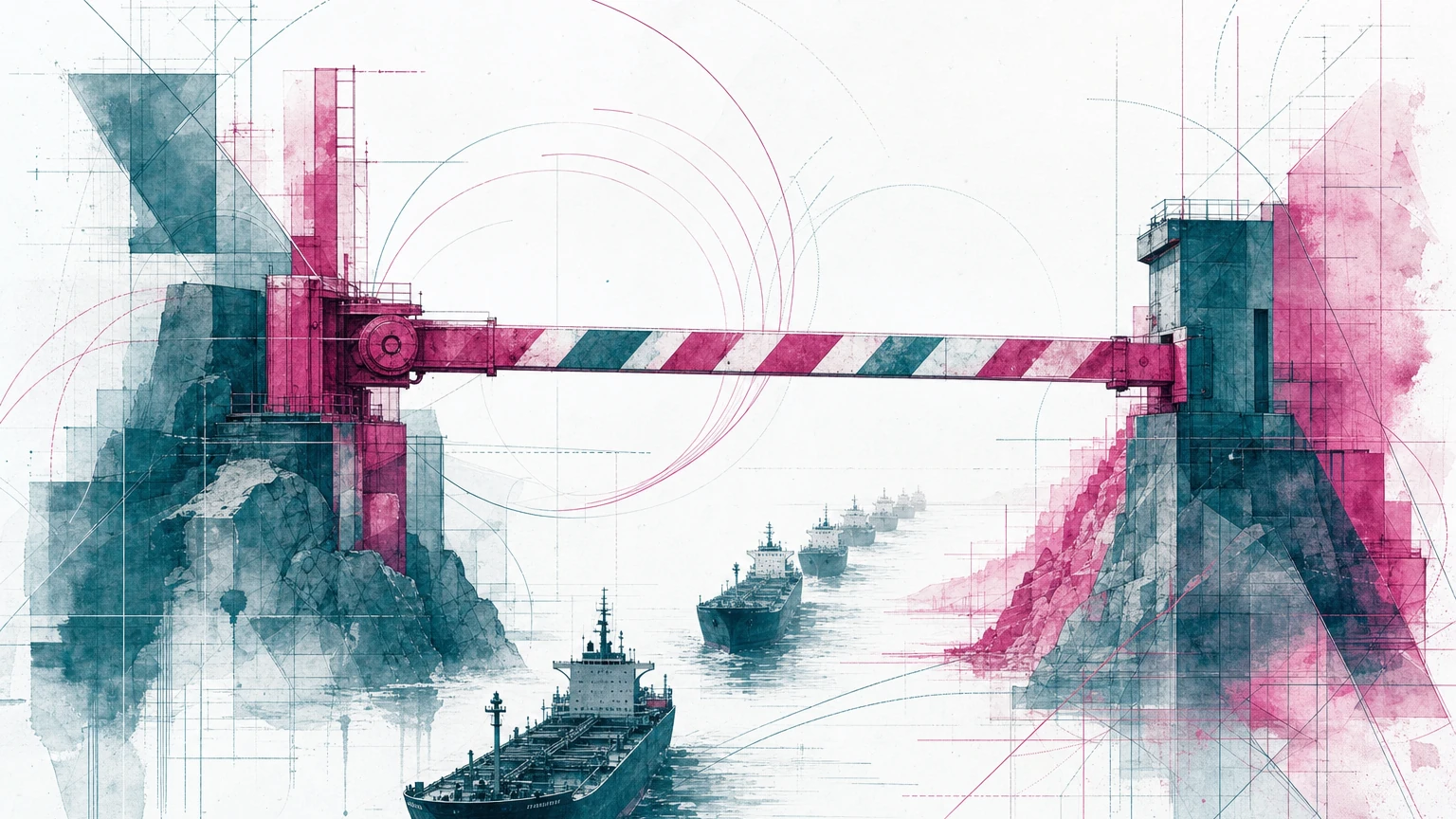
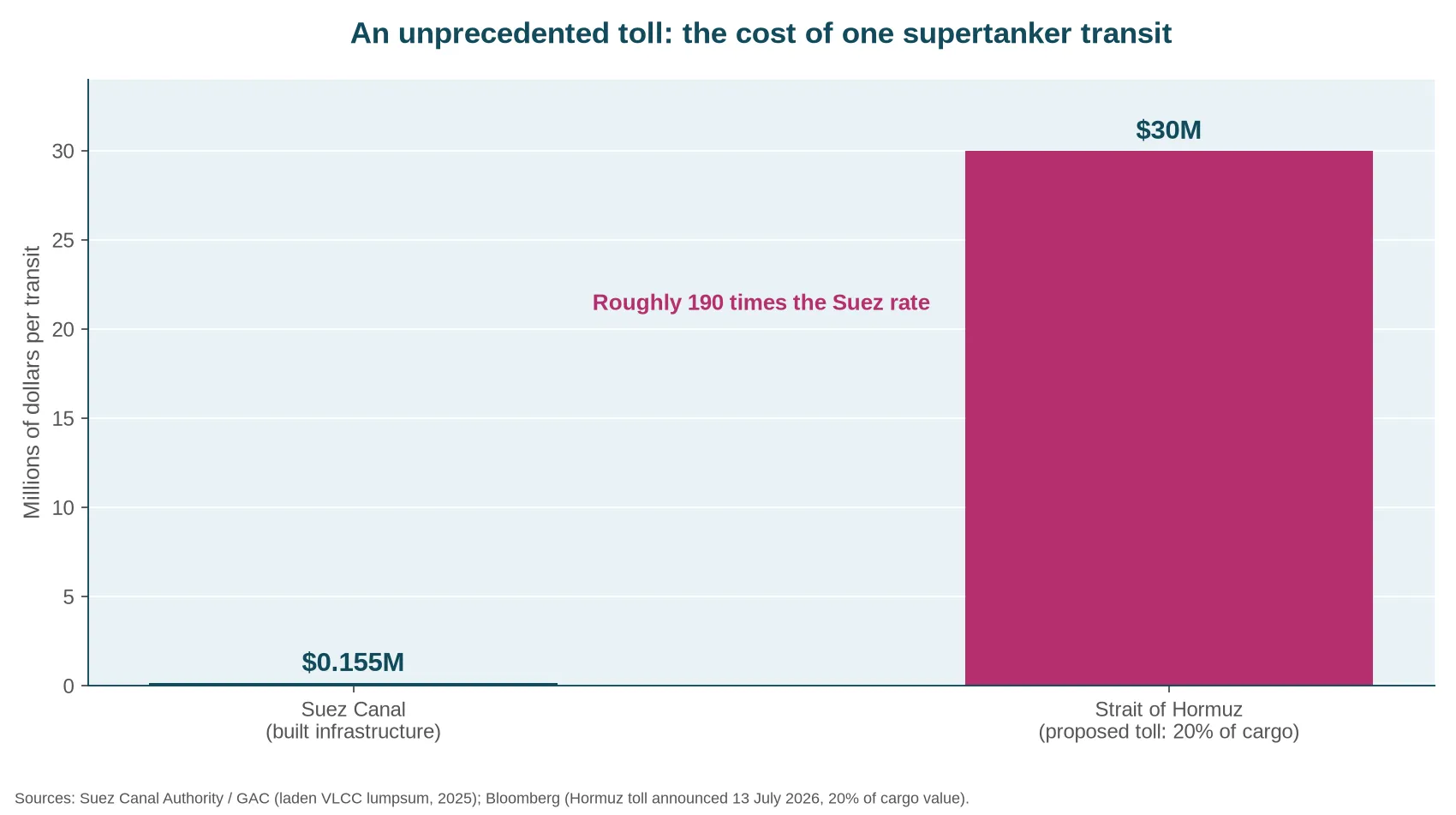
On 13 July 2026, Washington declared itself the “guardian” of the Strait of Hormuz and announced a 20% toll on all cargo passing through it, roughly $30 million for a fully laden supertanker. The International Maritime Organization replied that no legal basis exists for such a charge. Brent crude jumped more than 8%, to $82 a barrel.
Why it matters
The legal distinction comes down to one word: canal or strait. A canal (Suez, Panama) is infrastructure dug, maintained and financed by a state. The toll pays for a service rendered: about $155,000 for a supertanker at Suez. A strait is a natural waterway. The UN Convention on the Law of the Sea guarantees “transit passage” through it: a right, not a service, which the bordering state can neither suspend nor invoice. Nobody owns Hormuz, not the states on its shores, and not the navy patrolling it.
Which raises the deeper question, one that has little to do with oil: what is an international rule worth when no one enforces it? The IMO can state that there is no legal basis. It has no means of stopping anything. The same mechanism has been replaying since 1945: institutions designed to arbitrate between powers, whose authority ends precisely where the authority of the most powerful begins. That is not a temporary malfunction, it is the original design.
The precedent reaches far beyond the Gulf. Around thirty international straits carry the bulk of world seaborne trade: Malacca, Gibraltar, the Bosphorus, Bab el-Mandeb. If passage through them becomes billable by whoever controls the water, then it is no longer law that sets the price of shipping. It is force.
To understand why an international rule can be broken without consequence, read the Fundamental: “International institutions: who really sets the rules.”
You’ll learn why a single veto has been enough to paralyse the Security Council since 1945, how 16.5% of the voting rights is enough to hand the United States a de facto veto at the IMF, where major decisions require an 85% majority, and why great powers can sidestep the rules they wrote themselves.
Read the Fundamental →